When a loan officer asks how long a grace period you want, most borrowers hesitate. They are told the obvious part, that paying interest only makes the early years cheap, but nobody hands them the two numbers that actually matter. Bank glossaries stop at a one-line definition: a grace period is the stretch when you pay interest only.
The two questions people are really asking are these. First, what does the monthly payment become in the exact month the grace period ends? Second, how much extra total interest does that convenience cost? This article answers both with worked figures from a 300 million KRW mortgage and a 50 million KRW student or personal loan. Every number below can be reproduced by entering the same inputs into the loan repayment calculator.
1. The grace period and the repayment period are two segments of the same loan
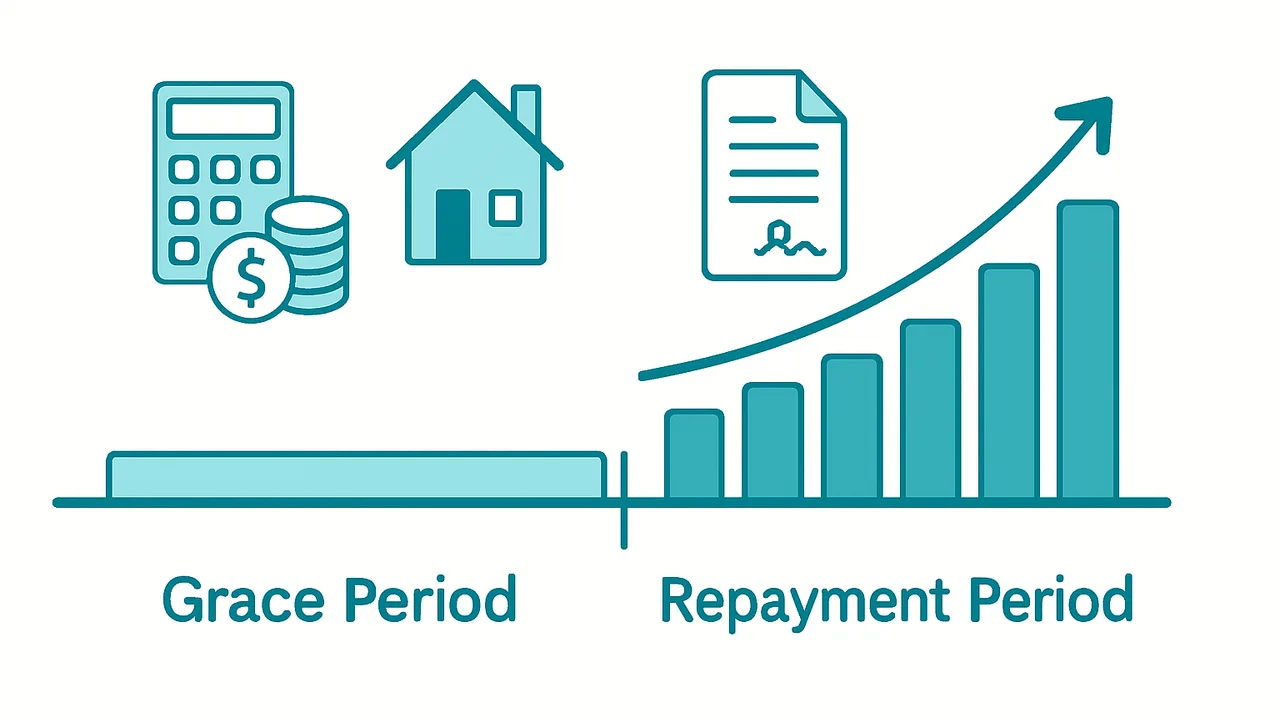
The two terms are not alternatives. They are the front and back halves of a single loan term.
- The grace period is the stretch where you pay interest only. The outstanding principal does not move at all.
- The repayment period is the stretch where you pay principal plus interest until the balance reaches zero. This is the only part of the loan where your debt actually shrinks.
A contract typically reads something like "30-year term (3-year grace, 27-year repayment)". That means you have agreed to clear 300 million KRW over 30 years, but for the first 36 months you touch none of the principal, and the whole 300 million has to be repaid across the remaining 324 months.
Here is the part most borrowers miss. A grace period is not free time added to the loan but time borrowed from the repayment period. If the maturity date is fixed at 30 years, choosing a three-year grace period shrinks your principal repayment window to 27 years. Repaying the same principal over fewer months mathematically forces the monthly payment up.
| Aspect | Grace period | Repayment period |
|---|---|---|
| What you pay monthly | Interest only | Principal + interest |
| Outstanding balance | Unchanged | Falls every month |
| Monthly payment level | Low | High |
| Effect of the interest paid | Does nothing to reduce principal | Balance falls, so interest falls too |
| Effect of making it longer | Lower payments now, more total interest | Higher payments now, less total interest |
2. The payment jumps because the number of amortizing months shrinks
The monthly payment on an equal-payment (annuity) loan is set by the formula below, where r is the monthly rate (annual rate divided by 12) and n is the number of months in which principal is actually repaid.
Monthly payment = P × r × (1+r)^n ÷ ((1+r)^n − 1)
A grace period leaves P untouched while cutting n. Take 300 million KRW at 4.5% a year.
- With no grace period, spreading it over 360 months gives 1,520,056 KRW a month.
- With a 36-month grace period, the same 300 million must be amortized over 324 months, giving 1,601,161 KRW a month.
So the post-grace payment is always higher than the payment you would have had without a grace period. But the shock a household feels is not that gap. During the grace period the amount actually leaving the account was interest only: 1,125,000 KRW a month, which is 300 million times 4.5% divided by 12. Measured by what leaves the account, the payment goes from 1,125,000 to 1,601,161 KRW in a single month. That is 476,161 KRW more, a 42.3% increase.
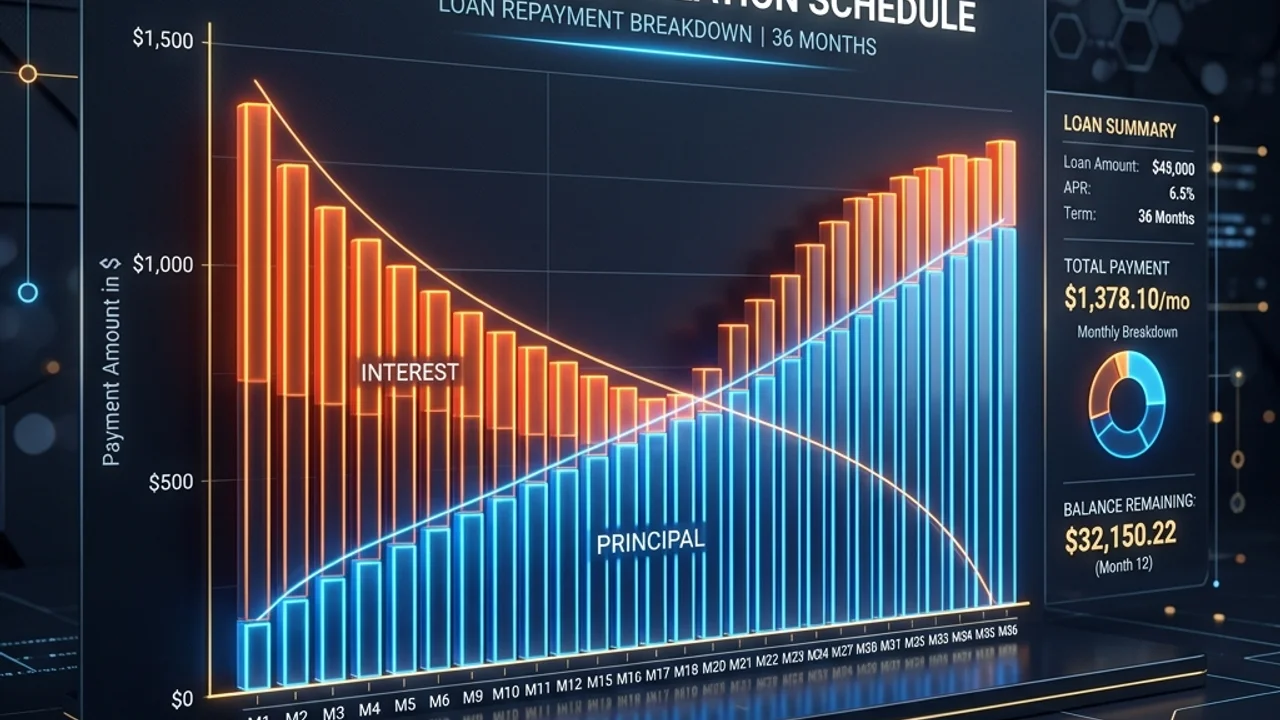
For a household that has spent three years building a budget around the interest-only figure, that 42% lands all at once. It is why so many people start searching only after the bank sends a notice that principal repayment is about to begin. If you want the mechanics in more depth, the amortization formula calculation guide breaks a payment down into principal and interest month by month.
3. A 300 million KRW mortgage with 0, 1, 3 and 5 years of grace
Inputs: 300 million KRW principal, 4.5% fixed annual rate, 30-year (360-month) term, equal-payment amortization. The grace period sits inside the 30-year term.
| Grace period | Payment during grace | Payment after grace | Increase | Total interest | Vs no grace |
|---|---|---|---|---|---|
| None | — | 1,520,056 | — | 247,220,123 | — |
| 12 months | 1,125,000 | 1,544,980 | +37.3% | 251,152,991 | +3,932,868 |
| 36 months | 1,125,000 | 1,601,161 | +42.3% | 259,276,445 | +12,056,322 |
| 60 months | 1,125,000 | 1,667,497 | +48.2% | 267,749,360 | +20,529,237 |
Three things are worth reading out of that table.
First, the payment during the grace period is identical regardless of how long the grace period is. Because the principal never falls, the interest stays at 1,125,000 KRW every month. Choosing one year or five years changes nothing about that stretch. It only changes how heavy the back half becomes.
Second, the jump when the grace period ends runs between 37% and 48%. After five years of grace you owe roughly 1.48 times the interest-only figure every month. If income has not grown by a comparable amount, the household runs a deficit from that month on.
Third, total interest grows by roughly 4 million KRW for each year of grace. Five years of grace costs an extra 20.52 million KRW. That is the pure price of holding 300 million KRW without reducing it for five years.
Note also that the extra interest is not strictly proportional to the length of the grace period. One year adds 3.93 million, three years 12.06 million, five years 20.53 million. The later principal repayment starts, the longer a large balance sits accruing interest, so the cost accelerates.
4. Whether the grace period sits inside the term or in front of it changes the total
The same phrase "three-year grace" describes two different structures depending on the product. Get this wrong and the numbers you type into a calculator are wrong from the start.
- Inside the term. A 30-year loan contains a three-year grace period, so principal is amortized over 27 years. This is the common mortgage and rental-deposit loan structure.
- In front of the term. A three-year grace period is followed by a fresh 30-year repayment schedule, making the contract 33 years long. Student loans and some policy loans work this way.
| Structure | Total contract | Payment during grace | Payment after grace | Total interest |
|---|---|---|---|---|
| No grace, 30-year repayment | 360 months | — | 1,520,056 | 247,220,123 |
| Grace inside term (3 + 27) | 360 months | 1,125,000 | 1,601,161 | 259,276,445 |
| Grace in front (3 + 30) | 396 months | 1,125,000 | 1,520,056 | 287,720,123 |
The split is instructive. With the grace period in front, the payment after the grace period is 1,520,056 KRW, exactly what it would have been with no grace period at all. There is no jump, which is far easier to live with. The price is total interest of 287.72 million KRW, which is 28.44 million more than the inside-the-term version and 40.5 million more than taking no grace at all. That 40.5 million is precisely 1,125,000 multiplied by 36 months, the interest paid while the principal stood still.
In short, putting the grace period inside the term buys lower total interest at the cost of a payment jump, while putting it in front removes the jump at the cost of interest. Which one suits you depends on whether your income three years from now is genuinely higher than it is today.
To model each one, enter a 30-year term with 36 grace months for the first structure and a 33-year term with 36 grace months for the second. The loan repayment calculator takes the term in years, extra months, and grace months as separate fields, so both structures go in exactly as written.
5. Short loans produce far larger jumps
The shock at the end of a grace period grows as the loan term shortens, because the grace period eats a larger share of the schedule. Here is 50 million KRW at 5.0% over a 10-year (120-month) term.
| Grace period | Payment during grace | Payment after grace | Increase | Total interest | Vs no grace |
|---|---|---|---|---|---|
| None | — | 530,328 | — | 13,639,291 | — |
| 12 months | 208,333 | 575,864 | +176.4% | 14,693,261 | +1,053,970 |
| 24 months | 208,333 | 632,996 | +203.8% | 15,767,613 | +2,128,322 |
With 24 months of grace the payment goes from the 200,000s to the 630,000s, more than tripling. Set that against the 42% on the mortgage and the difference is obvious. This is exactly how a graduate who took a generous grace period on a student loan ends up with a tripled payment in their second year of work.
A 20-year, 100 million KRW loan sits in between as a useful reference. At 4.5% with 24 grace months, the payment rises from 375,000 to 676,325 KRW, an 80.4% increase, and total interest grows by 3.25 million. The rule of thumb is simple: the shorter the maturity, the more dangerous a grace period becomes.
6. Equal-payment and equal-principal schedules absorb the end of grace differently
The repayment method also changes the size of the jump. Inputs are 300 million KRW, 4.5%, 360 months, 36 grace months.
| Method | Payment during grace | First payment after grace | Increase | Total interest |
|---|---|---|---|---|
| Equal payment | 1,125,000 | 1,601,161 | +42.3% | 259,276,445 |
| Equal principal | 1,125,000 | 2,050,926 | +82.3% | 223,312,487 |
An equal-principal schedule nearly doubles the payment the month grace ends, but every payment afterwards is a little smaller, and total interest is 35.96 million KRW lower than the equal-payment version. The equal-payment schedule softens the jump and pays for it in interest. If you want a grace period and still want to keep interest down, equal principal wins, provided you can survive the cash flow of the first year or two after the switch. The loan repayment method comparison guide walks through both structures in more detail.
7. When a grace period makes sense, and when it costs you
A grace period is not good or bad in itself. It is a question of cash flow and planning. These criteria hold up well in practice.
Situations where a grace period is reasonable
- Closing costs, moving and renovation cluster right after move-in, and you only need one or two years of breathing room. One year of grace on a 300 million KRW loan costs 3.93 million in extra interest, generally cheaper than taking out a high-rate personal loan to cover the gap.
- A confirmed income increase lands when the grace period ends: returning from parental leave, recovering a rental deposit, receiving a severance payout. The date and the amount both need to be known.
- You expect to sell or refinance within the grace period, so you never reach the amortizing segment at all.
Situations where a grace period backfires
- You are only using it to shrink the monthly figure enough to pass underwriting. The principal is still there, and nothing about the picture three years later has improved.
- The loan matures in ten years or less, where the payment can triple as shown above.
- The rate is high. The higher the rate, the more expensive it is to hold an untouched balance.
One caveat worth adding: debt-service ratio checks are often run on the post-grace payment, so a grace period may not raise your borrowing limit at all. If the limit itself is the question, put your income and existing obligations into the loan limit calculator first.
8. Three things to check once the end-of-grace notice arrives
Receiving the notice that principal repayment is about to begin still leaves you options.
1) Ask whether the grace period can be extended
Many products allow an extension, usually subject to a cap on total grace months and a fresh review. It helps in the short run, but it shortens the remaining repayment window further, so the next jump is larger. Check how much extra total interest each additional year of grace costs before agreeing.
2) Pay down principal before the switch
Paying part of the principal just before the grace period ends lowers every payment afterwards by the same proportion. Paying 30 million KRW off a 300 million balance cuts the subsequent payment by roughly 10%. If you are still inside the early-repayment fee window, usually three years from drawdown, compare the fee against the interest saved with the prepayment fee calculator before you commit.
3) Refinance into a different structure
If rates have fallen, refinancing with a longer maturity lowers the monthly payment. Total interest still rises, so run the refinanced terms through a calculator and compare total interest against your current contract before deciding.
All three share one property. Every option that lowers the monthly burden raises total interest, without exception. The only way to decide well is to look at the falling payment and the rising total on the same screen.
9. Frequently asked questions
Q1. Does the interest paid during the grace period come off the principal later?
No. Everything paid during the grace period is interest, and the outstanding principal is untouched by it. After three years of grace on a 300 million KRW loan you will have paid 40.5 million KRW and still owe the full 300 million. This is the single biggest misunderstanding about grace periods.
Q2. Is a zero-month grace period always the better choice?
On total interest alone, yes. In every table above, no grace produced the lowest total interest. But it also carries the highest payment from month one, so the real test is whether you can sustain that figure for years. A missed payment costs far more than interest, so a short grace period can beat an unaffordable schedule with none.
Q3. Can I repay principal during the grace period?
Usually yes, and it is the most effective move available. Voluntary repayment during the grace period cuts the balance, which lowers both the interest and every payment that follows. Just check the early-repayment fee window, typically three years from drawdown, and weigh the fee against the saving.
Q4. Does "30-year term, 3-year grace" mean 30 years of repayment or 27?
It depends on the product. Most mortgages place the three-year grace period inside the 30-year term, leaving 27 years of amortization. Student loans and some policy loans start a fresh repayment schedule after the grace period instead. Check the first principal repayment date and the final maturity date on your contract, then compare the two structures in the table in section 4.
10. Run your own numbers in the loan repayment calculator
The figures here use representative inputs: 300 million KRW, 4.5%, 30 years. Your decision needs your principal, your rate and your maturity. The loan repayment calculator takes the loan amount, annual rate and term along with a grace period field in months, and shows the payment during the grace period next to the payment after it on the same screen. Run it three times with the grace field set to 0, 12 and 36, and you have both numbers this article is about: how many percent the payment jumps, and how much total interest the grace period costs. To compare the two structures from section 4, change only the term, 30 years versus 33.
If you want to know whether a grace period raises your borrowing limit, check the loan limit calculator first. If you plan to pay down principal before the grace period ends, compare the fee against the saving with the prepayment fee calculator. To reconsider the repayment method itself, see the loan repayment method comparison guide, and for the mechanics behind each payment, the amortization formula calculation guide.
Every calculation runs inside your browser and the amounts you type are never sent to a server, so you can enter your real loan terms without hesitation.