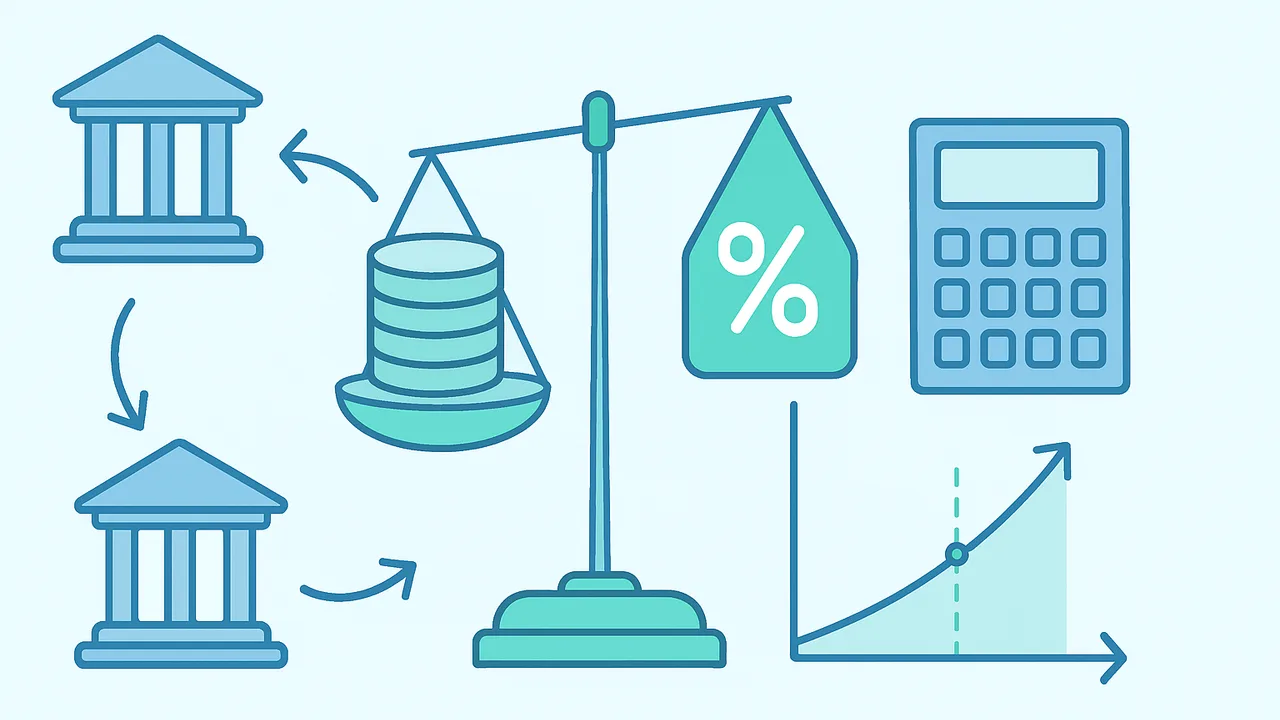
When applying for a home purchase mortgage, a student loan, or a personal credit loan, the first and most critical choice you must make is: "Which loan repayment method would you like to use?" How you choose to pay back the principal and interest every month determines not only the size of your monthly living budget but also the total amount of interest you will pay back to the bank by the end of the loan term.
For first-time borrowers, bank jargon can make it extremely difficult to decide. Many borrowers casually choose equal principal and interest payments simply because "having a fixed monthly bill is easier to manage," only to realize years later that they paid thousands of dollars in unnecessary interest. In this guide, we break down the structure of Equal Principal, Equal Principal & Interest, and Bullet Repayment methods, along with the math behind interest calculations, to help you make the smartest choice.
1. Core Concepts and Structural Differences
Loan interest is calculated based on the remaining outstanding principal (unpaid loan balance). As the principal is paid down, the next month's interest decreases. Therefore, how fast you pay down the principal dictates how much interest you accrue.
Equal Principal and Interest Payments (Amortized)
- Structure: The sum of your 'principal + interest' remains exactly the same every month throughout the loan term.
- How it works: In the beginning, because the unpaid balance is at its peak, interest makes up the bulk of your monthly payment. Over time, as the principal decreases, the interest portion shrinks, while the principal portion of your payment grows.
Equal Principal Payments
- Structure: You repay the exact same amount of 'principal' every month (loan amount divided by months), plus the interest calculated on the remaining balance.
- How it works: Since the principal drops at a steady, rapid rate, the outstanding balance decreases faster than any other method. The monthly interest decreases accordingly, making your total monthly bill shrink over time.
Bullet / Interest-Only Repayment
- Structure: You pay only the 'interest' every month during the loan term, and pay back the entire principal in a single lump sum on the maturity date.
- How it works: Since you do not touch the principal until the end, your interest payments remain at the maximum level every month. This yields the highest total cost.
| Repayment Method | Monthly Payment Trend | Total Interest Burden | Initial Budget Pressure | Suitability for Early Payoff |
|---|---|---|---|---|
| Equal Principal & Interest | Completely flat/constant | Moderate | Medium (predictable cash flow) | Moderate (slower early principal drop) |
| Equal Principal | Highest at start, decreases | Lowest (minimizes interest) | High (budget-heavy initially) | Excellent (fast principal reduction) |
| Bullet (Interest-Only) | Flat interest, huge final bill | Highest (maximum interest) | Very Low (minimum monthly cost) | Only when cash flow is needed |
2. Mathematical Comparison and Example
To illustrate, let us analyze a scenario using a loan calculator: a $100,000 loan, a 10-year term (120 months), at a 5.0% fixed annual interest rate.
Simulation Results ($100,000 Loan, 5.0% Rate, 10-Year Term)
- Equal Principal and Interest:
- Monthly Payment: $1,060.66 (identical for 120 months)
- Month 1 Breakdown: Principal $643.99 + Interest $416.67
- Month 60 Breakdown: Principal $825.91 + Interest $234.75
- Total Interest Paid: $27,278.63
- Equal Principal:
- Monthly Principal Repayment: $833.33 ($100,000 / 120)
- Month 1 Payment: Principal $833.33 + Interest $416.67 = $1,250.00 (highest)
- Month 120 Payment: Principal $833.33 + Interest $3.47 = $836.81 (lowest)
- Total Interest Paid: $25,208.33
- Bullet (Interest-Only):
- Monthly Payment: $416.67 (only interest)
- Final Payment: $100,000.00
- Total Interest Paid: $50,000.00 (nearly double the equal principal method)
As shown above, simply choosing the Equal Principal method saves you $2,070 in interest compared to the Amortized method. When compared to the Bullet method, the savings jump to a massive $24,791.
3. How to Choose the Right Strategy for Your Finances
While minimizing interest is ideal, Equal Principal payments are not for everyone. You must align your decision with your cash flow and financial stability.
Choose Equal Principal if:
- You have strong initial income: Because the monthly payments are highest in the first few years, this is suitable for households with stable or high current income who can handle the heavy early payments.
- You want to minimize total cost: If you are focused on financial efficiency and want to pay the absolute least to the bank, this is the optimal choice.
- You plan to pay off the loan early: Because your principal balance drops rapidly, you pay less in early-payment penalties and clear the debt faster.
Choose Equal Principal & Interest if:
- You prefer a predictable budget: Having a fixed bill makes it easy to plan monthly expenses without worrying about fluctuating costs.
- You need lower initial payments: It reduces the pressure on your wallet during the first few years of the loan, which is helpful for young couples or first-time homebuyers who have high upfront moving costs.
4. Frequently Asked Questions (FAQ)
Q1. Can I change my repayment method halfway through my loan term?
In most commercial banks, once a loan is finalized and disbursed, you cannot change the repayment method. Changing it requires refinancing—fully paying off the existing loan and taking out a new one under a new contract. Always run the numbers carefully before signing.
Q2. How is a grace period different from repayment methods?
A grace period is a set time (e.g., 1 to 3 years) at the beginning of a loan during which you pay only the interest, and do not repay any principal. Once the grace period ends, your amortized or equal principal payments begin. Setting a grace period increases the total interest paid since your principal remains untouched longer.
5. Calculate Smartly with a Financial Tool
Before taking out a loan, you should verify the exact figures for your monthly household budget.
Use our free Loan Repayment Calculator to generate a full amortization schedule showing how principal and interest split each period. Switch between equal-payment, equal-principal and interest-only on the same inputs to compare total interest, and export the table as CSV for a spreadsheet. If you are also interested in building wealth, read our Compound Interest Guide to learn how compounding interest works to grow your savings.