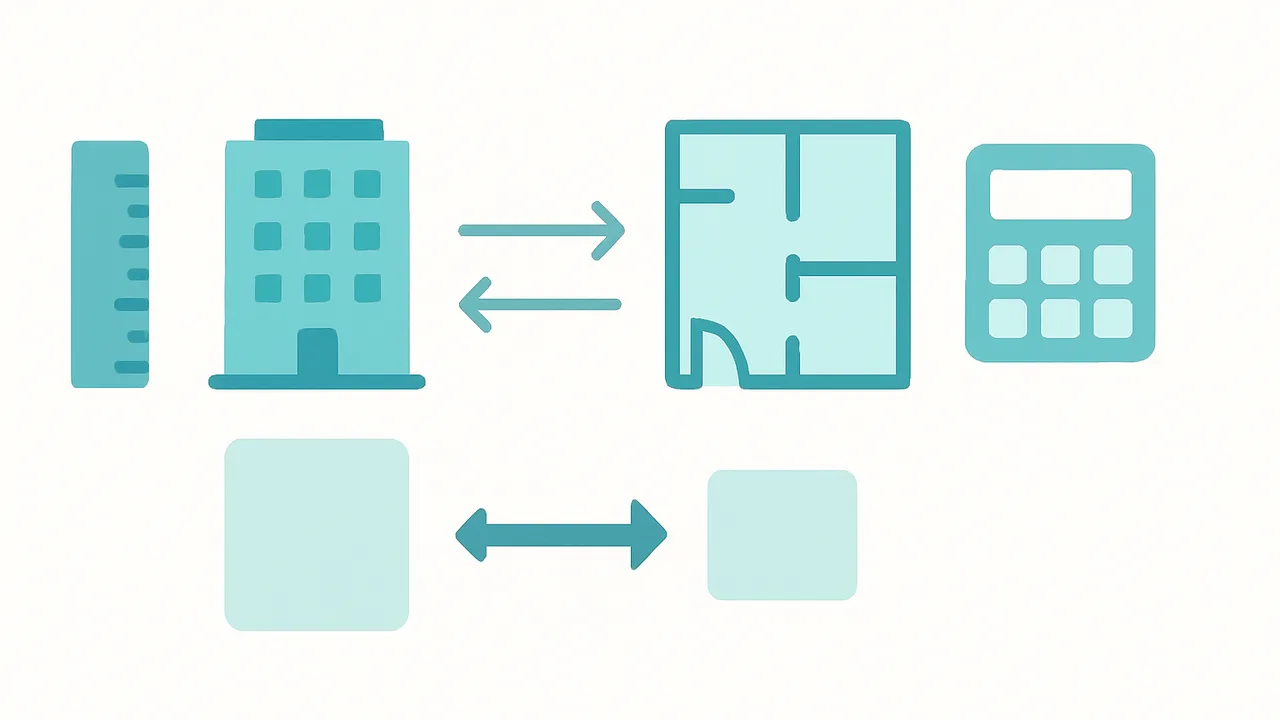
Open any Korean property listing and the unit size reads exclusive area 84.97 m². Call the agent about it and they say "the 34-pyeong one." Walk past the complex and the banner advertises "the national standard 84 type." One apartment, and the numbers 84 and 34 are both attached to it. Which one describes the home you would actually live in?
Both do. The 84 is the exclusive area written in square meters, and the 34 is the supply area converted into pyeong and used as a nickname. This guide starts with the raw numbers for every common type — 39, 49, 59, 74, 84, 101 and 114 m² — then walks through the arithmetic that turns 84 into "34-pyeong," and finally explains why the same 84 m² floor plan gets called anything from 32-pyeong to 35-pyeong depending on the complex.
1. Type-by-type conversion table: the numbers you came for
The conversion constant is fixed by definition. One pyeong equals 400/121 m², or about 3.3058 m². Going the other way, one square meter is exactly 0.3025 pyeong. Multiply and you have your answer.
The table below covers the types that dominate Korean apartment supply. The final column assumes an exclusive-area ratio of 75 percent, which is where most Korean apartments sit.
| Exclusive area | In pyeong | Supply area (at 75%) | Supply in pyeong | Common name |
|---|---|---|---|---|
| 39 m² | 11.8 pyeong | 52.0 m² | 15.7 pyeong | 16-pyeong |
| 49 m² | 14.8 pyeong | 65.3 m² | 19.8 pyeong | 20-pyeong |
| 59 m² | 17.9 pyeong | 78.7 m² | 23.8 pyeong | 24-pyeong |
| 74 m² | 22.4 pyeong | 98.7 m² | 29.8 pyeong | 30-pyeong |
| 84 m² | 25.4 pyeong | 112.0 m² | 33.9 pyeong | 34-pyeong |
| 101 m² | 30.6 pyeong | 134.7 m² | 40.7 pyeong | 40-pyeong |
| 114 m² | 34.5 pyeong | 152.0 m² | 46.0 pyeong | 45-pyeong |
Read down the columns and the oddity jumps out. Convert 84 m² directly and you get 25.4 pyeong, yet everyone calls it a 34-pyeong unit. Roughly 8.5 pyeong, or about 28 m², has gone missing. The same gap appears at 59 m²: genuinely 17.9 pyeong, universally called 24-pyeong. Explaining that gap is the point of this article.
Two multiplications worth memorizing
When you cannot reach for a calculator mid-viewing, two shortcuts cover almost every case.
- Exclusive area in m² × 0.3 = actual exclusive pyeong (slightly low; the exact factor is 0.3025)
- Exclusive area in m² × 0.4 = the pyeong number people will call it
The second shortcut is remarkably reliable. 84 × 0.4 = 33.6, so 34-pyeong. 59 × 0.4 = 23.6, so 24-pyeong. 74 × 0.4 = 29.6, so 30-pyeong. 114 × 0.4 = 45.6, so 45 or 46-pyeong. The factor 0.4 works because it corresponds to an exclusive-area ratio of about 75.6 percent, and Korean apartments cluster right around that figure.
2. Why 84 becomes 34: floor area has four layers
Korean real estate does not use a single definition of area. Depending on which boundary you measure to, the same apartment is 25 pyeong, 34 pyeong or 45 pyeong.
| Area type | What it includes | Example for an 84 type | Where it is used |
|---|---|---|---|
| Exclusive area | Everything inside your front door: rooms, living room, kitchen, bathrooms | about 84 m² | Property register, building ledger, transaction price data, taxes |
| Residential common area | Stairs, corridors, elevators shared within the building | about 28 m² | Maintenance fee calculation |
| Supply area (sale area) | Exclusive area plus residential common area | about 112 m² | The "N-pyeong" name, sale pricing |
| Contract area | Supply area plus other common areas: underground parking, management office, security post | roughly 150 m² | Officetel sales, contracts |
One more category sits outside all of these. The balcony counts as service area and appears in none of the four rows. That is why an expansion renovation visibly enlarges the space you walk on while every number on paper stays identical.
So the 84 m² printed on the listing is row one, the exclusive area. The name "34-pyeong" comes from row three, the supply area. Two different rulers produced those two numbers, which is exactly why they differ by 8.5 pyeong.
3. Working backwards with the exclusive-area ratio
The bridge between exclusive area and supply area is the exclusive-area ratio, the share of the supply area that is actually yours.
- Exclusive ratio = exclusive area ÷ supply area × 100
- Supply area = exclusive area ÷ exclusive ratio
- Pyeong name = supply area ÷ 3.3058
Take 84 m² at a 75 percent ratio. Supply area is 84 ÷ 0.75 = 112 m². Divide 112 by 3.3058 and you get 33.9 pyeong, which rounds to 34-pyeong. Two divisions turn the listing number into the nickname.
The reverse works just as well. When an agent mentions a 34-pyeong unit, multiply 34 × 3.3058 = 112.4 m² for the supply area, then multiply by 0.75 to recover roughly 84.3 m² of exclusive area. Since presale announcements label unit types by exclusive area, this reverse calculation lets you identify the actual type from marketing copy alone.
4. Why the same 84 m² ranges from 32 to 35-pyeong
Browse several 84 m² listings and one complex says 33-pyeong while another says 35-pyeong. The exclusive area is identical, so the only variable is how much residential common area the building carries. In other words, the exclusive-area ratio.
| Exclusive ratio | Supply area for 84 m² | In pyeong | Called | Typical layout |
|---|---|---|---|---|
| 72% | 116.7 m² | 35.3 pyeong | 35-pyeong | Corridor type, mixed-use towers, large amenity complexes |
| 75% | 112.0 m² | 33.9 pyeong | 34-pyeong | Standard slab-type stairwell apartments |
| 78% | 107.7 m² | 32.6 pyeong | 33-pyeong | Newer stairwell buildings with efficient cores |
| 80% | 105.0 m² | 31.8 pyeong | 32-pyeong | Designs that minimize shared space |
At 72 percent the unit is a 35-pyeong; at 80 percent the very same floor plan is a 32-pyeong. Three pyeong of difference on paper, zero difference inside the front door.
There is a counterintuitive lesson here. The instinct is that a bigger pyeong number is better value, but when exclusive area is held constant, the smaller pyeong number marks the more efficient building. Sale prices are generally set on supply area, so a complex selling 84 m² as a 35-pyeong unit is charging you for more shared space than one selling it as a 34-pyeong unit. The trade-off may well be worth it, in wider corridors or better amenities, so treat the ratio as a question to ask rather than a verdict on quality.
5. Why 84 and not 85: the national standard size
The 84 m² type carries the nickname "national standard size" in Korea. Why 84 rather than 85 or 83?
Korean housing law defines the national housing scale as a residential exclusive area of 85 m² or less. In eup and myeon areas outside the capital region and outside designated urban zones, the threshold rises to 100 m². Crossing that 85 m² line changes several things at once.
- Housing at or below the national scale is exempt from value-added tax on the building portion at the time of sale.
- Above 85 m² of exclusive area, an additional special rural development tax of 0.2 percent is added to acquisition tax.
- Subscription special-supply allocations and national housing fund support both use 85 m² as a dividing line.
Developers therefore design as large as possible without crossing the threshold, which is why listings show 84.97 m² or 84.99 m², decimals pressed right up against the limit. For reference, 84.99 m² converts to 25.71 pyeong, and 85 m² is likewise 25.71 pyeong. The 101 and 114 m² types sit above the line, so their acquisition-stage tax burden is slightly heavier.
It is also worth knowing why square meters lead in advertising at all. Under Korea's measurement law, property listings and advertisements have been required to use the legal metric unit since July 2007. Pyeong lost its official status but never left everyday speech, leaving Koreans permanently bilingual: paperwork in square meters, conversation in pyeong.
6. Which area matters in which situation
| Situation | Area to check | Why |
|---|---|---|
| Comparing actual transaction prices | Exclusive area | The ministry's transaction disclosure system reports by exclusive area |
| Acquisition, property and comprehensive real estate tax | Exclusive area | The 85 m² threshold decides the rural development surtax |
| Price per unit area | Supply area | The familiar "per 3.3 m²" figure is based on supply area |
| Estimating maintenance fees | Supply area and the ratio | A larger common area enlarges the fee base |
| Evaluating an officetel | Always check exclusive area | Officetels are sold on contract area, so ratios fall to 40 to 50 percent |
| Judging how the space will feel | Exclusive area plus balcony expansion | Service area appears in none of the official figures |
Officetels deserve particular caution. Apartments are named by supply area while officetels are frequently named by contract area, so two units both advertised as "24-pyeong" may hold 59 m² and 40-something m² of exclusive space respectively. Comparing the nicknames alone will badly mislead you, so always pull the exclusive-area figure in square meters for an officetel.
Balcony expansion matters too, especially in older buildings. Two 84 types, one expanded and one not, differ noticeably in the usable width of the living room and bedrooms while sharing identical paperwork. Ask about expansion status separately during a viewing.
7. In Square Feet: The Same Types for Foreign Readers
| Type (exclusive m²) | Exclusive area in sq ft | Common pyeong name |
|---|---|---|
| 59 | ≈ 635 | 24-pyeong |
| 74 | ≈ 797 | 30-pyeong |
| 84 | ≈ 904 | 34-pyeong |
| 101 | ≈ 1,087 | 40-pyeong |
Use the exclusive area in square feet when comparing with homes abroad — it is the space inside the door. If you are renting, the deposit and monthly rent matter more than the type name; see the brokerage fee calculator for the agent fee on a jeonse or wolse lease.
8. Frequently asked questions
Q1. Exactly how many pyeong is 84 m²?
84 × 0.3025 = 25.41 pyeong. Real listings usually carry decimals such as 84.97 or 84.99 m²; at 84.99 m² the figure is 25.71 pyeong. Either way, remember it as the mid-25 pyeong range.
Q2. So why do people call it 34-pyeong?
Because 34 comes from the supply area, not the exclusive area. Adding roughly 28 m² of stairs, corridors and elevator space to the 84 m² interior yields about 112 m² of supply area, which converts to 33.9 pyeong and gets rounded to 34. Think of 25.4 pyeong as your home and 34 pyeong as your home plus its share of the building.
Q3. Complex A calls its 84 m² a 33-pyeong and complex B calls it a 35-pyeong. Which is right?
Both are. The difference is the exclusive-area ratio. At 78 percent the supply area is 107.7 m², or 33-pyeong; at 72 percent it is 116.7 m², or 35-pyeong. The space behind the front door is effectively the same in both, and only the shared portion differs.
Q4. How do I tell whether a listed square meter figure is exclusive or supply area?
Property registers, building ledgers, the transaction disclosure system and presale unit-type labels all use exclusive area. Anything phrased as "N-pyeong," and any per-3.3 m² price, uses supply area. As a rough check on apartments, a figure in the 80s or 90s of square meters is almost always exclusive area, and a figure in the 110s or 120s listed alongside it is the supply area.
9. Converting your own listing numbers instantly
The arithmetic above is only a few multiplications, but comparing a dozen listings full of values like 84.97, 59.82 and 101.94 by hand gets tedious fast. Drop the square meter figure straight into the pyeong calculator and the pyeong value appears immediately, with the reverse direction available too. The exact workflow this article walks through, converting the exclusive area to real pyeong and then dividing by the exclusive ratio to reach the supply area and the pyeong name, runs automatically where you were otherwise punching numbers. It also converts width and depth in meters into an area, which is handy for sizing a single room during a viewing.
When other units enter the picture, pair it with the unit converter. Square footage on an overseas listing or a ceiling height quoted in inches resolves on the same screen. If the underlying measurement systems interest you, the practical unit converter and measurement standards guide covers how the metric and imperial systems diverge.
You no longer need to hesitate at a square meter figure in a listing app. Multiply by 0.3025 for the real pyeong, multiply by 0.4 for the name people will use, and 84, 59 and 101 all read instantly.