You finally have spare cash and decide to clear part of a loan early, only to be told at the branch that a prepayment fee applies. Most search results stop at a single line: "after three years there is no fee." What you actually need to know is when that three-year clock starts, whether anything can be done before it runs out, and how much money would leave your account if you repaid today.
This guide answers those three questions in order. It starts with the legal time limit that stops a bank from charging at all, moves on to the partial repayment waiver and other exceptions that apply while you are still inside the charging window, compares typical rates across mortgage, credit, jeonse and policy loans, and ends with the three numbers you need to calculate your own figure.
1. The first exemption is three years from the disbursement date
A prepayment fee is not a penalty a bank may set at will. The Financial Consumer Protection Act treats charging a consumer for repaying early as an unfair business practice and prohibits it in principle. The enforcement decree then carves out exceptions, and the main one covers repayment within three years of taking out the loan. Read the other way around: money repaid after the three-year mark cannot carry a fee.
The most common mistake is picking the wrong starting date. None of the following is the reference point:
- The application date or the credit approval date
- The date your first principal-and-interest installment began (with a grace period this can be years after disbursement)
- An annual limit renewal or review date
- Three years counted backwards from maturity
The clock starts on the date the money actually landed in your account. For a loan disbursed on 5 October 2023, anything repaid after 5 October 2026 carries no fee. A day or two either side can be worth hundreds of thousands of won, so check the disbursement date on the first page of your loan agreement before you transfer anything.
One caveat: if you increased the loan amount or signed a new agreement to change its terms, that portion may count as a new loan with its own three-year window. When several drawdowns sit under one account number, count the elapsed period for each one separately.
2. Inside the window, the amount shrinks as time passes
Being inside the charging period does not mean paying the headline rate in full. Most Korean banks use a sliding scale that decays toward zero as the window runs out:
Prepayment fee = principal repaid × fee rate × (days remaining ÷ charging period)
Take 50 million won repaid early at a 1.2% rate with a three-year charging period. The amount changes sharply depending on how much of the window has elapsed.
| Elapsed | Remaining window | Proration factor | Fee (KRW 50m principal, 1.2%) |
|---|---|---|---|
| 6 months | 30 months | 0.833 | KRW 500,000 |
| 12 months | 24 months | 0.667 | KRW 400,000 |
| 18 months | 18 months | 0.500 | KRW 300,000 |
| 24 months | 12 months | 0.333 | KRW 200,000 |
| 30 months | 6 months | 0.167 | KRW 100,000 |
| 35 months | 1 month | 0.028 | about KRW 17,000 |
| Over 36 months | 0 | 0 | Zero |
Delaying repayment by six months can cut the fee by a six-figure amount in won. That is why there is rarely a reason to rush when only a couple of months of the window remain. Conversely, if refinancing saves a large amount of interest, paying the fee and moving may still win: the two numbers have to be compared side by side.
3. Four routes to a waiver before the window closes
You do not have to simply wait out the clock. Four exemption routes come up most often in practice.
One: the annual partial repayment waiver. Many loan agreements include a clause stating that repayments up to a set share of the outstanding balance each year, commonly around 10%, carry no prepayment fee. On a 300 million won mortgage that means roughly 30 million won of principal can be cleared each year for free. If you need to repay 50 million won, splitting it across the waiver limit instead of paying it all at once is the cheaper route.
The arithmetic is concrete. Repaying 50 million won at a 1.2% rate with 24 months elapsed costs 200,000 won if the whole amount is charged. Apply a 30 million won waiver and charge only the remaining 20 million won, and the fee drops to 80,000 won. Whether the clause exists, and at what percentage, varies by bank and product, so the agreement is the first thing to read.
Two: restructuring within the same bank. Switching from a variable to a fixed rate, or adjusting the repayment method, keeps the money inside the same lender, and many banks waive or discount the fee in those cases. Temporary waivers to encourage fixed-rate conversion also appear repeatedly during rate-rising cycles.
Three: an accepted interest rate reduction request. If your income or credit score has improved, having the rate cut is a change of terms rather than a repayment, so no prepayment fee arises at all. It is the cheapest way to lower your burden and is worth trying before you look at refinancing elsewhere.
Four: products that never charge in the first place. Deposit-secured loans, revolving credit lines (negative-balance accounts) and some policy or low-income support products fall here. A credit line charges interest only on what you actually draw, so early repayment barely disturbs the bank's funding plan, though some such products charge an unused-limit fee instead.
| Exemption route | When it applies | Where to confirm |
|---|---|---|
| Charging period elapsed | More than three years since disbursement | Loan agreement, banking app loan detail |
| Annual partial repayment waiver | Repayment within roughly 10% of balance per year | Special clauses in the agreement, branch |
| Restructuring at the same bank | Rate type or repayment method change | Your branch, bank notices |
| Rate reduction request accepted | Income or credit improvement | Rate reduction menu in the banking app |
| Product carries no fee | Deposit-secured loan, credit line | Fee section of the product disclosure |
| Special contractual grounds | Death, inheritance and similar bank-defined cases | Credit transaction terms, branch |
4. Rates and charging periods differ by product
There is no single answer to "what is the prepayment fee rate." It depends on whether the loan is secured, what the money is for, and which institution issued it. The typical spread looks like this.
| Loan type | Typical rate range | Charging period | Notes |
|---|---|---|---|
| Bank mortgage | about 0.6-1.4% | 3 years | Sliding scale; differs for fixed vs variable |
| Bank credit loan | about 0.4-0.8% | 3 years | Generally lower than mortgages |
| Jeonse deposit loan | about 0.5-1.2% | 3 years | Wide variation by guarantor and product |
| Policy mortgage | about 0.7-1.2% | 3 years | Sliding scale; some products include waivers |
| Revolving credit line | usually none | – | Some carry an unused-limit fee instead |
| Non-bank lenders | higher than banks | Varies | Charging window can be shorter than three years |
One structural change is worth noting. Regulators reworked how these fees are calculated so that banks may only recover costs they actually incur, and rates on newly issued loans trended lower afterwards. Loans disbursed before that change still follow the rate written into the original agreement, so for an older loan the rate in your own agreement is what counts, not the figure currently published on the bank's website. Checking the rate shown in the loan detail screen of your banking app, or in the Federation of Banks disclosures, removes the guesswork.
5. Three steps to find the date your fee hits zero
You only need three numbers.
- Find the disbursement date. It is on the first page of the agreement or in the loan detail screen of your banking app. Add three years and you have the date the fee disappears.
- Find the contractual rate and charging period. Around 1% over three years (36 months) is the common shape, but products differ.
- Enter the elapsed months and the principal you intend to repay. Multiply by the remaining-window ratio shown above.
Once you have the number, the decision becomes a simple comparison. Refinancing a 300 million won mortgage from 4.5% to 3.7% saves roughly 2.4 million won of interest in the first year alone. One year into a 1.2% three-year window, the fee is about 2.4 million won, so the move pays for itself in around a year and everything after that is pure saving. If only a year of the term remains, however, the interest saved is unlikely to clear the fee. Rather than accepting a refinancing pitch at face value, write both figures down over the same horizon and compare them.
6. Frequently asked questions (FAQ)
Q1. Once three years pass, is it really zero?
Amounts repaid more than three years after the disbursement date cannot carry a prepayment fee. The reference date is the disbursement date the bank has on record, and any increase or new agreement starts its own three-year count. If several drawdowns share one account, check each disbursement date individually.
Q2. Does a partial repayment also trigger a fee?
In principle yes, proportional to the principal repaid. But where an annual partial repayment waiver exists, everything up to that limit is free. With such a clause, spreading repayments across years up to the waiver limit costs far less in total than one large lump sum.
Q3. Why do credit lines have no prepayment fee?
A revolving credit line charges interest only on the balance you actually use, so paying it down does not disrupt the bank's funding plan in the way a term loan does. Some of these products charge an unused-limit fee instead, which is listed in the fee section of the product disclosure.
Q4. Is refinancing worth it even after paying the fee?
It depends on the rate gap and the remaining term. If the time needed for the interest saving to exceed the fee is shorter than the remaining term, refinancing wins. With a short remaining term or a gap under about 0.3 percentage points, the payback period stretches out and the benefit shrinks.
7. Get your own number with the prepayment fee calculator
"How much would it cost to repay today" comes down to putting four numbers into the proration formula: principal repaid, fee rate, months elapsed and charging period. Enter those in the prepayment fee calculator and it returns the remaining window and the exact fee. Changing only the elapsed months shows how much you would save by waiting a few more months, which is precisely the input you need to pick a repayment date.
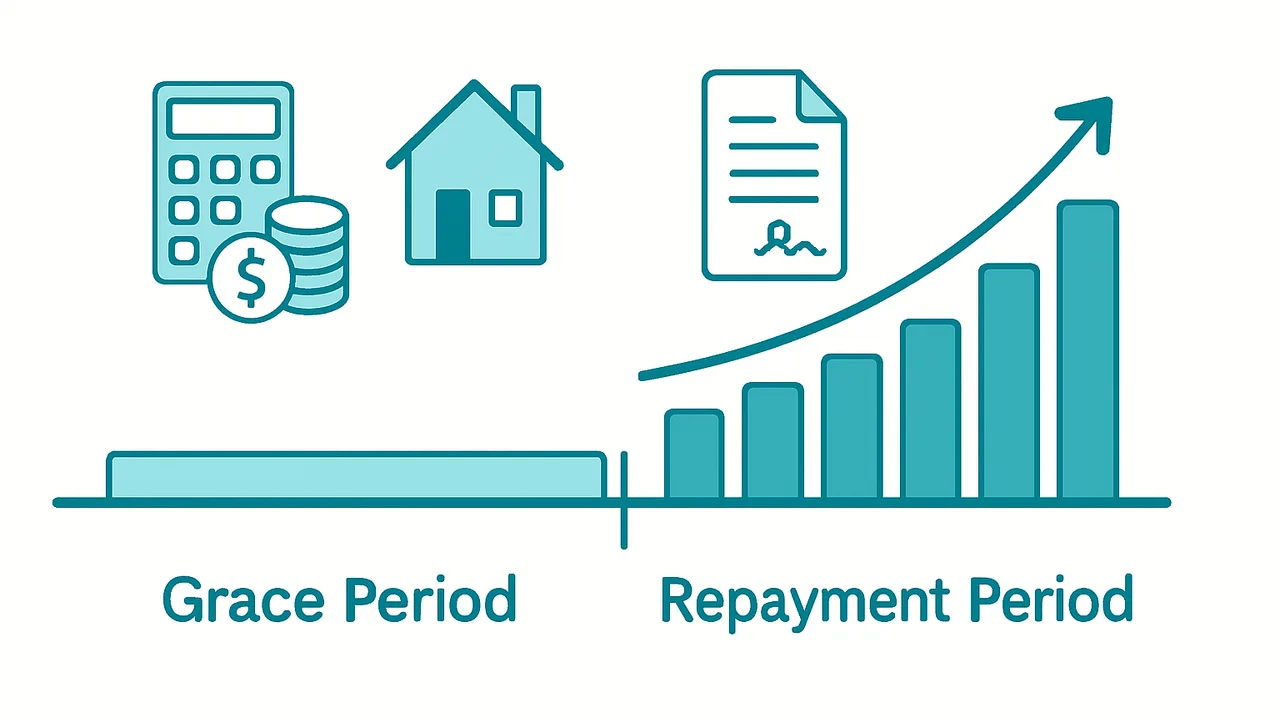
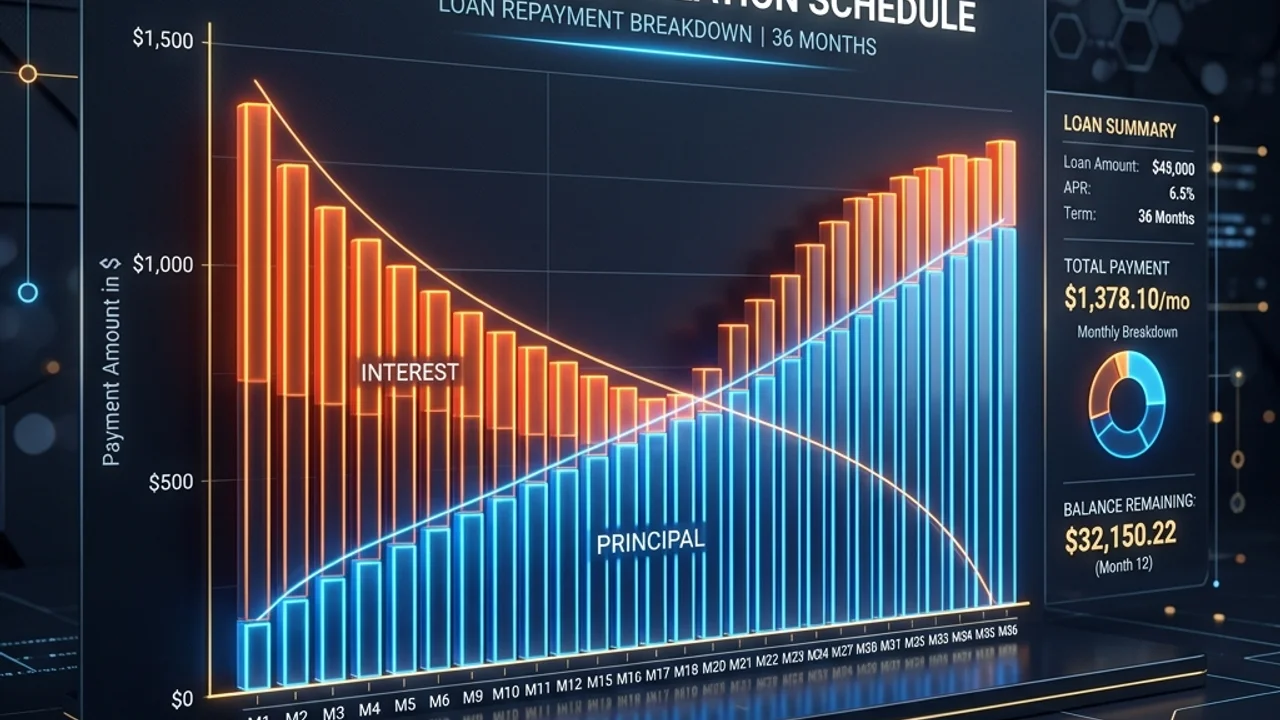
If you are weighing whether to pay the fee and refinance, run both the current rate and the new rate through the loan repayment calculator and check when the difference in total interest overtakes the fee. If a grace period is still running and your installment is about to jump, grace period vs repayment period covers that, and how amortization is calculated explains how each installment splits between principal and interest.