If your partner's family celebrates birthdays by the lunar calendar, or you have just been told that a grandparent's memorial rite (jesa, 제사) falls "on the 15th of the leap third month," you quickly run into a question that most calendar apps do not answer: which years actually have a leap month, and what happens in the years that do not?
The short answer for right now: there is no leap month in 2026 or 2027. The next one in the Korean lunar calendar is the leap 5th month of 2028. This guide gives you a verified table of every Korean leap month from 2017 to 2034, explains why leap months exist and how often they come, and then covers the part that matters most in practice: how Korean families keep birthdays and memorial days that fall in a leap month.
1. Every Korean leap month from 2017 to 2034
The table below lists each leap month (yundal, 윤달) and the solar (Gregorian) dates it covers. 2014 and 2036 are included so you can see the rhythm on either side.
| Year | Leap month | Solar dates | Length | Gap from previous |
|---|---|---|---|---|
| 2014 | Leap 9th month | Oct 24 – Nov 21, 2014 | 29 days | — |
| 2017 | Leap 5th month | Jun 24 – Jul 22, 2017 | 29 days | 3 years |
| 2020 | Leap 4th month | May 23 – Jun 20, 2020 | 29 days | 3 years |
| 2023 | Leap 2nd month | Mar 22 – Apr 19, 2023 | 29 days | 3 years |
| 2025 | Leap 6th month | Jul 25 – Aug 22, 2025 | 29 days | 2 years |
| 2028 | Leap 5th month | Jun 23 – Jul 21, 2028 | 29 days | 3 years |
| 2031 | Leap 3rd month | Apr 22 – May 20, 2031 | 29 days | 3 years |
| 2033 | Leap 11th month | Dec 22, 2033 – Jan 19, 2034 | 29 days | 2 years |
| 2036 | Leap 6th month | Jul 23 – Aug 21, 2036 | 30 days | 3 years |
So between 2017 and 2034, seven lunar years contain a leap month: 2017, 2020, 2023, 2025, 2028, 2031 and 2033. Every other year in that range has the normal twelve months.
Watch out for 2033. Its leap 11th month starts on December 22, 2033 and runs into January 2034 on the solar calendar. If you see a source claiming "2034 has a leap month," it is usually describing this same leap month by its solar end date. By lunar year, 2034 has none.
Korean and Chinese calendars sometimes disagree
If you have seen 2017 listed as having a "leap 6th month," that source almost certainly follows the Chinese calendar. Korea calculates new moons and solar terms on Korea Standard Time (the 135°E meridian), while China uses the 120°E meridian. Most of the time the results match, but when a new moon or solar term falls close to midnight, the date can shift by a day and move the leap month with it. In 2017, Korea had a leap 5th month while China had a leap 6th month. For Korean family events, always use a Korean lunar calendar source.
2. What a leap month is: the bonus month that fixes an 11-day gap
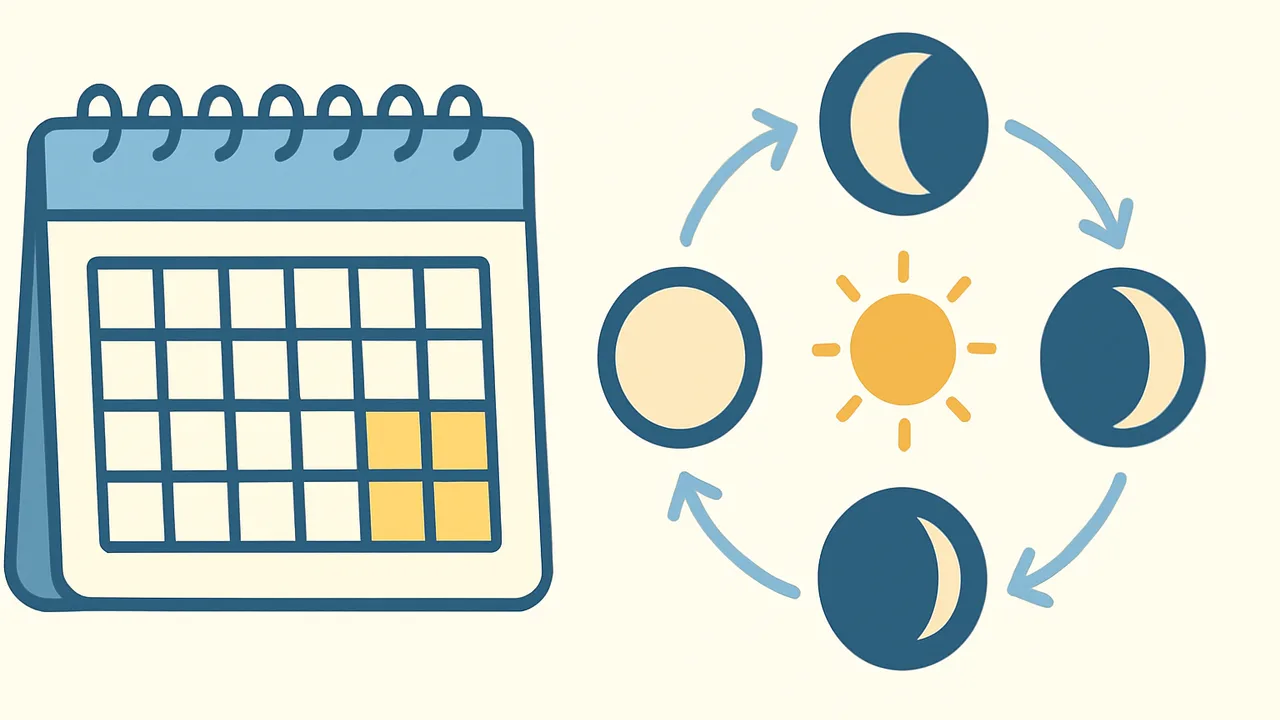
A leap month is an extra month inserted into a lunar year every few years, giving that year thirteen months instead of twelve. It exists because the Moon and the Sun keep different time:
- One lunar cycle (new moon to new moon) averages about 29.53 days, so lunar months have either 29 or 30 days.
- Twelve lunar months add up to roughly 354 days, about 11 days shorter than the solar year of about 365.24 days.
- Left alone, that gap grows past a full month in three years, and within a couple of decades the "5th month" would land in midwinter.
For an agricultural society that planned planting and harvest by the calendar, drifting seasons were a real problem. So whenever the gap reached about one month, an extra month was slipped in to pull the lunar dates back in line with the seasons. Koreans traditionally called it a "bonus month" or "spare month" (deotdal, gongdal) because it sits outside the regular twelve.
A leap month takes the number of the month just before it. If it comes after the 4th month, it is called the leap 4th month, and that year effectively has two 4th months. The original one is called the regular month (pyeongdal, 평달). That distinction between the regular month and the leap month is the key to the birthday and memorial questions later in this guide.
3. How often leap months come: 7 times in 19 years
Look at the gaps in the table: 3, 3, 3, 2, 3, 3, 2 years. Leap months arrive every two or three years, and the logic behind that comes from the 19-year Metonic cycle.
| Item | Calculation | Days |
|---|---|---|
| 19 solar years | 365.2422 × 19 | about 6,939.60 |
| 235 lunar months | 29.5306 × 235 | about 6,939.69 |
| Make-up of 235 months | 12 × 19 + 7 | 7 leap months |
Nineteen solar years and 235 lunar months line up to within a fraction of a day. Since 19 ordinary lunar years contain only 228 months, seven extra months are needed to reach 235. Over the long run, that means seven leap months every 19 years, or one roughly every 2.7 years: five three-year gaps and two two-year gaps, repeating.
Modern Korean calendars, however, do not apply the 19-year rule mechanically. They place each leap month by actual astronomical calculation, so the same month does not necessarily repeat 19 years later. 2017 had a leap 5th month, but 2036, nineteen years on, has a leap 6th month. Think of "seven in nineteen" as a rule for how many leap months occur and how far apart they are on average, not for exactly which month they land on.
4. Why a particular month becomes the leap month
Why was 2023's leap month the 2nd and 2033's the 11th? The answer lies in the 24 solar terms.
The solar terms divide the Sun's yearly path into 24 segments of 15 degrees each. Every second one is a "principal term" (junggi, 중기), such as the spring equinox, summer solstice, autumn equinox and winter solstice. Each lunar month is supposed to contain one principal term, and the term it contains decides its number; the month containing the winter solstice, for instance, is the 11th month.
Principal terms are, on average, about 30.44 days apart, slightly longer than a lunar month of 29.53 days. Every so often, a lunar month falls entirely between two principal terms and contains none. The Korean calendar makes that month the leap month. If it follows the 4th month, it becomes the leap 4th month; if it follows the 11th, it becomes the leap 11th month.
Why winter leap months are rare
Most leap months fall between the 2nd and 6th months, and leap 11th, 12th or 1st months are very rare. Earth is closest to the Sun in early January, when the Sun appears to move fastest along its path, so winter principal terms are only about 29.5 days apart. With such short spacing, a month without a principal term almost never occurs in winter. In summer the spacing stretches past 31 days, making leap months far more likely. That is exactly why the 2033 leap 11th month gets so much attention.
5. Leap-month birthdays: celebrated on the regular month
A person born in a leap month faces a problem the very next year, because that particular leap month may not return for a decade or far longer. Even common ones like the leap 4th or 5th month take at least 11 years to come back, and rarer ones can take generations.
Korean custom therefore celebrates a leap-month birthday on the same day of the regular month. Someone born on the 10th day of the leap 5th month celebrates on the 10th day of the 5th lunar month each year.
Here is how that plays out for a child born on day 10 of the leap 5th month in 2017 (July 3, 2017 on the solar calendar):
| Year | Lunar date used | Solar date | Note |
|---|---|---|---|
| 2026 | 5th month, day 10 | June 24 | No leap month, use regular month |
| 2027 | 5th month, day 10 | June 14 | No leap month, use regular month |
| 2028 | 5th month, day 10 | June 2 | If the family keeps the regular month |
| 2028 | Leap 5th month, day 10 | July 2 | The birth leap month returns |
In a year like 2028, when the same leap month comes back, families have a choice. Many simply keep the regular-month date (June 2), while others make a special occasion of the "true" birthday on the leap-month date (July 2). There is no fixed rule, so it is worth agreeing on one as a family.
If the birthday is on day 30
Lunar months end on day 29 in some years and day 30 in others, and as the table shows, leap months are usually 29 days long. If someone was born on day 30 of a leap month, or on day 30 of a regular month that has only 29 days in a given year, the birthday is usually kept on the last day of that month, day 29. This is the most common source of off-by-one errors when converting lunar birthdays, so check the actual calendar for that year.
6. Memorial rites (jesa) for someone who died in a leap month
Korean ancestral memorial rites (gijesa, 기제사) are held on the anniversary of the death, so a death in a leap month raises the same question. The prevailing custom matches the birthday rule: observe the rite on the same day of the regular month. If someone passed away on the 15th day of the leap 3rd month, the memorial day is the 15th day of the 3rd lunar month every year.
| Situation | Common practice | What to check |
|---|---|---|
| Died in a leap month; this year has no such leap month | Same day of the regular month | If that month has 29 days, a day-30 rite moves to day 29 |
| Died in a leap month; the same leap month returns this year | Most families still use the regular month | Some use the leap month, so follow family custom |
| Died in a regular month; this year also has a leap month of that number | Keep the regular-month date | No second rite in the leap month |
| Family uses a solar date for the rite | Same solar date every year | Leap months do not matter |
For example, for someone who died on day 15 of the leap 2nd month in 2023 (April 5, 2023), the regular-month memorial dates fall on March 24, 2024, March 14, 2025, April 2, 2026 and March 22, 2027. Because the same lunar date shifts by ten days or more on the solar calendar each year, siblings often share the coming year's solar date early so everyone can plan travel.
To avoid the confusion entirely, a growing number of families now fix memorial days to the solar date. Either approach is fine; what matters is that the family agrees and stays consistent. The most common mistake happens right after a funeral, when the first anniversary is set without checking whether the date of death was in a leap month.
7. For foreigners in Korea: what actually changes
If you live in Korea and have married into a Korean family, or simply want to keep track of colleagues' holidays, a few practical points help:
- Official dates are solar. Resident registration, residence cards, visa expiry dates, contracts and legal deadlines all use the Gregorian calendar. A leap month never changes any official date or your legal age.
- Lunar dates only matter for family occasions and traditional holidays. Seollal (Lunar New Year) and Chuseok move every year on the solar calendar, and so do lunar birthdays and memorial days of older relatives.
- Ask whether a date is "regular" or "leap." When relatives give you a lunar date, confirming pyeongdal (regular month) or yundal (leap month) avoids being a month off in years like 2028.
- Expect leap-month customs. In leap-month years you may hear about relocating ancestral graves, preparing burial clothes for parents, or avoiding weddings, because the leap month was traditionally seen as a "month without spirits watching." These are folk customs, not rules, but older relatives may care about them.
8. Frequently asked questions (FAQ)
Q1. Is there a leap month in 2026 or 2027?
No. After the leap 6th month of 2025, the next Korean leap month is the leap 5th month of 2028 (June 23 to July 21, 2028 on the solar calendar). After that come the leap 3rd month of 2031 and the leap 11th month of 2033.
Q2. Exactly how often does a leap month occur?
There is no fixed interval; it is usually every two or three years. Over the long run, seven leap months occur every 19 years, an average of one every 2.7 years. Which month becomes the leap month is decided by astronomical calculation, so a specific leap month can take decades to recur.
Q3. Does being born in a leap month affect official documents or age?
No. Official birth dates and age calculations in Korea use the solar calendar. The leap-month question only comes up when families celebrate birthdays or hold memorial rites by the lunar calendar.
Q4. If I was born in a regular month and that year also has a leap month of the same number, do I celebrate twice?
No. A regular-month birthday is kept once, on the regular-month date. For example, someone born on day 10 of the 5th month celebrates on June 2 in 2028; the 10th day of the leap 5th month a month later is not their birthday.
9. Check this year's leap month and memorial dates with the converter
The table and examples here were all calculated from Korean lunar calendar data, but every family's dates are different, so the surest way is to enter them yourself. In the Lunar to Solar Calendar Converter, enter a year and lunar date on the lunar-to-solar tab to get the solar date instantly. If you tick the leap-month box for a year that has no such leap month, the tool tells you which month actually is the leap month that year, so you can see at once whether a leap-month birthday should move to the regular month or whether the true leap month has come back. It also flags day 30 in years when that month ends on day 29, catching the classic off-by-one mistake.
Once you have the solar date, use the countdown in the Date Calculator to see how many days remain until the next birthday or memorial day, which makes it easier to coordinate with family and book time off.