Introduction
In health, fitness, and medical contexts, Body Mass Index (BMI) is one of the most widely used metrics to classify weight status. BMI is an inexpensive and straightforward screening tool designed to estimate whether an adult has a healthy proportion of body weight relative to their height. By categorizing individuals into groups such as underweight, normal weight, overweight, and obese, health professionals can quickly identify potential risk factors associated with body weight.
However, calculating BMI manually can sometimes lead to confusion due to differences in units. Depending on where you live, you might use either the Metric system (meters and kilograms) or the Imperial system (inches and pounds). This guide explains the scientific basis of BMI, details the exact formulas required for both system configurations, and offers the World Health Organization (WHO) standard classification table to help you analyze your results.
BMI Formulas: Metric vs. Imperial Calculations
To compute your BMI, you divide your body weight by the square of your height. The units of measurement you choose dictate which mathematical formula you must apply.
1. The Metric BMI Formula
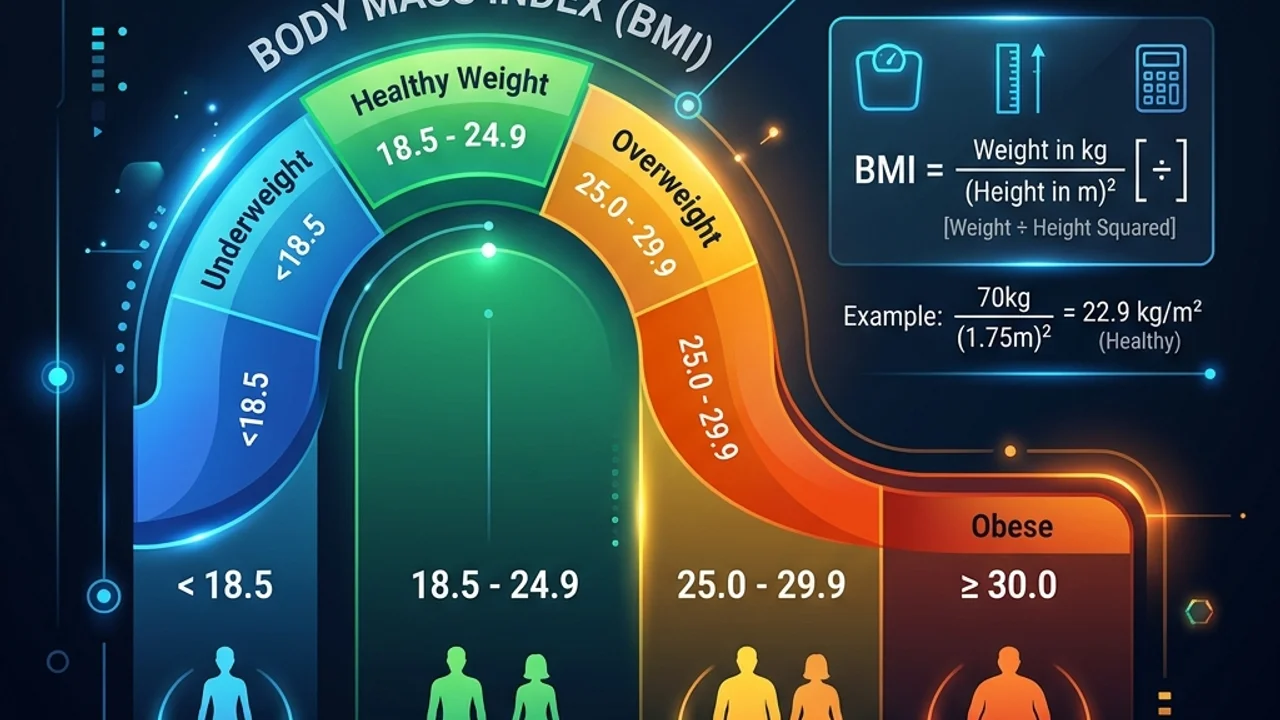
The Metric system is the international standard used by the WHO and most countries worldwide. Weight is measured in kilograms (kg) and height in meters (m). BMI = Weight (kg) / Height (m)^2
- Example: For an adult who is 1.75 meters tall (175 cm) and weighs 70 kilograms: BMI = 70 / (1.75 × 1.75) = 70 / 3.0625 ≈ 22.86
2. The Imperial BMI Formula
The Imperial system is primarily used in the United States. Weight is measured in pounds (lbs) and height in inches (in). Because this unit scale differs, you must multiply the numerator by a conversion constant of 703 to align the results with the metric scale.
BMI = Weight (lbs) / Height (in)^2 × 703
- Example: For an adult who is 69 inches tall and weighs 154 pounds: BMI = 154 / (69 × 69) × 703 = 154 / 4761 × 703 ≈ 22.74
World Health Organization (WHO) BMI Classifications
Once you calculate your BMI score, you can match it against standard categories defined by the World Health Organization. These thresholds apply generally to adults aged 20 and older, regardless of sex or age:
| Category | BMI Range (kg/m²) | Health Risk Assessment |
|---|---|---|
| Underweight | Under 18.5 | High risk of nutritional deficiencies |
| Normal Weight | 18.5 to 24.9 | Low risk of weight-related diseases |
| Overweight | 25.0 to 29.9 | Elevated risk of cardiovascular strain |
| Obesity Class I (Moderate) | 30.0 to 34.9 | High risk of type 2 diabetes and hypertension |
| Obesity Class II (Severe) | 35.0 to 39.9 | Very high health risks |
| Obesity Class III (Morbid) | 40.0 and above | Extremely severe clinical health risks |
Note: Some health organizations recommend lower overweight/obese thresholds (e.g., overweight starting at 23.0) for East Asian populations, due to research showing that health risks rise at lower BMI values in these demographics.
Limitations of Body Mass Index (BMI)
While BMI is an excellent general screening tool, it does have limitations. It does not measure body fat percentage or body composition directly. It cannot distinguish between muscle mass and fat tissue. For instance, a bodybuilder with a high percentage of lean muscle might register as "overweight" or "obese" according to their BMI. Conversely, an elderly individual with low muscle mass and high body fat might receive a "normal" BMI score, masking a condition known as sarcopenic obesity. Therefore, it is best to view BMI as a starting point and consult with medical professionals for detailed evaluations (like body fat testing or waist circumference measurements).
Quick and Free BMI Calculator Tool
To calculate your BMI instantly without using scratch paper, you can use our built-in utility. It handles both Metric and Imperial configurations automatically:
- Our Tool: /en/tools/bmi-calculator - Enter height and weight to get your BMI and weight category instantly. Metric and imperial units, processed in your browser.
Related Finance and Savings Guides
- /en/blog/compound-interest-savings-guide - Smart Savings: Understanding Compound Interest vs. Simple Interest
- /en/blog/loan-repayment-calculator-guide - How to Pick Your Loan Repayment Method: Amortization and Interest Structures