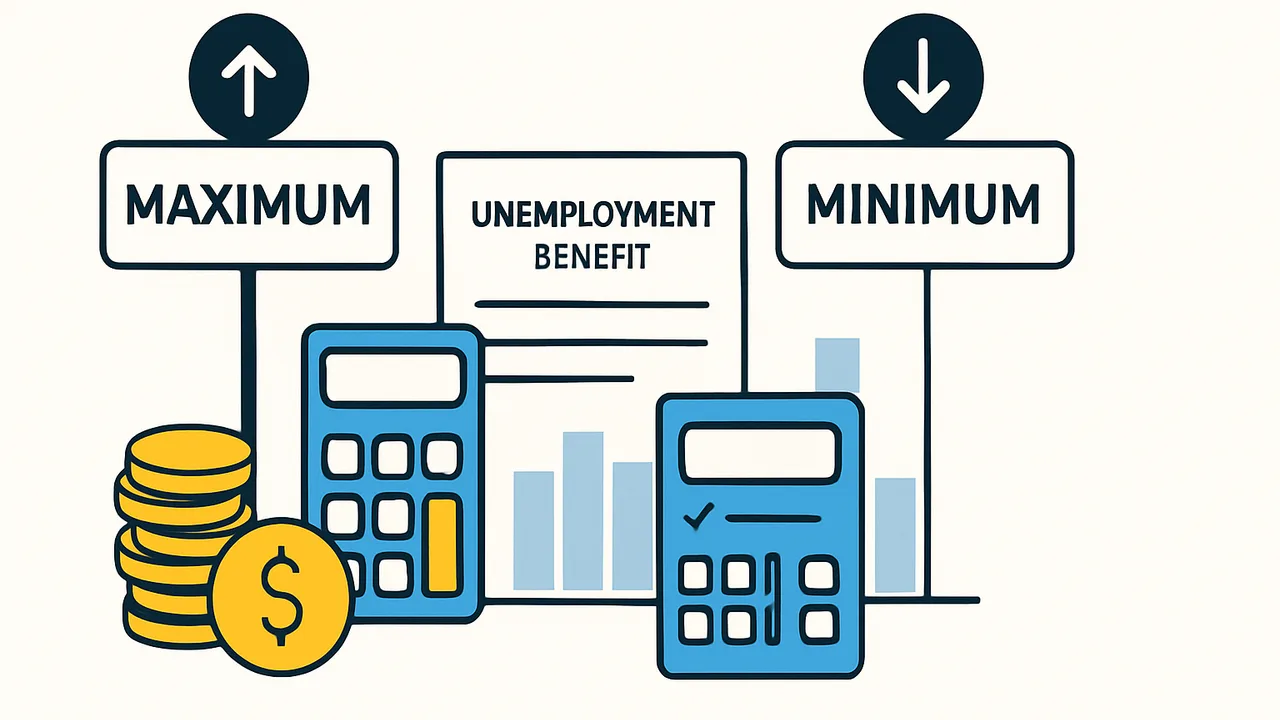
If you are about to leave your job in Korea, or you already have, one question tends to come up first: "How much will I actually receive in unemployment benefit per day?" Korea's unemployment benefit (officially the "jobseeker benefit," 구직급여) is not simply a continuation of your old salary. It is calculated as a percentage of your average wage, then bounded by a statutory upper limit and lower limit. Earn a very high salary, and your daily payout is still capped. Earn close to minimum wage, and your daily payout will not fall below the floor.
This guide walks through how the daily jobseeker benefit amount is calculated for 2026, what the exact upper and lower limits are, sample payout tables across different average wage levels, and how long benefits last based on your age and insured employment period. At the end, you can plug your own numbers into a calculator to get a precise estimate in seconds.
1. Why the Upper and Lower Limits Matter More Than the "60%" Headline
Most explanations of Korea's unemployment benefit stop at "you get 60% of your average wage," which is technically true but incomplete. The 60% figure is only the starting point of the calculation — the result is then compared against two boundaries and adjusted accordingly.
Workers who had a relatively high salary are often surprised that their actual daily benefit is much lower than 60% of what they earned, because the upper limit caps the payout regardless of income. Conversely, workers who earned close to minimum wage sometimes receive more than a strict 60% calculation would suggest, because the lower limit is tied directly to the minimum wage. To accurately predict your own benefit, you need to run both the formula and the two boundary checks together.
2. How the Daily Jobseeker Benefit Amount Is Calculated
Step 1: The base formula — 60% of average wage
The daily jobseeker benefit is calculated as 60% of your average daily wage over the final three months before separation.
Daily Benefit = Average Daily Wage (last 3 months before separation) × 60%
Average daily wage here follows the standard Labor Standards Act method: total wages paid over the last three months, divided by the total number of calendar days in that period.
Step 2: The upper limit — the absolute ceiling
For separations occurring on or after January 1, 2026, the daily upper limit for the jobseeker benefit is KRW 68,100. No matter how high your average wage was, your daily benefit cannot exceed this amount. Over a 30-day month, that works out to roughly KRW 2.04 million as the practical ceiling for monthly unemployment benefit income.
Step 3: The lower limit — tied to minimum wage
The lower limit is calculated as 80% of the minimum hourly wage, multiplied by 8 standard working hours per day. With the 2026 minimum wage confirmed at KRW 10,320 per hour, the lower limit is:
Lower Limit = Minimum Hourly Wage × 80% × 8 hours
            = KRW 10,320 × 0.8 × 8
            = KRW 66,048
So the 2026 daily lower limit for the jobseeker benefit is KRW 66,048. Because this figure moves in lockstep with the annual minimum wage adjustment, expect it to change every year.
Both the upper and lower limits are revised annually through the minimum wage announcement and enforcement decree amendments under the Employment Insurance Act. The figures above apply to separations from January 1, 2026 onward. Always double-check the latest confirmed figures on the Employment Insurance website (ei.go.kr), since these numbers are updated every year.
3. Sample Calculations and Comparison Tables
Numbers make more sense with concrete examples. Here is how a straight 60% calculation compares against the actual applied benefit once the upper and lower limits kick in, across a range of average daily wages.
Daily Benefit by Average Wage Level (2026 figures)
| Average Daily Wage | Simple 60% Calculation | Actual Daily Benefit Applied | Rule Applied |
|---|---|---|---|
| KRW 70,000 | KRW 42,000 | KRW 66,048 | Lower limit applied |
| KRW 90,000 | KRW 54,000 | KRW 66,048 | Lower limit applied |
| KRW 110,000 | KRW 66,000 | KRW 66,048 | Lower limit applied |
| KRW 130,000 | KRW 78,000 | KRW 68,100 | Upper limit applied |
| KRW 150,000 | KRW 90,000 | KRW 68,100 | Upper limit applied |
| KRW 200,000 | KRW 120,000 | KRW 68,100 | Upper limit applied |
As the table shows, if your average daily wage is below roughly KRW 110,000, the 60% calculation falls under the lower limit, so the lower limit (KRW 66,048) is applied instead. If your average daily wage exceeds roughly KRW 113,500, the 60% calculation exceeds the upper limit, so the upper limit (KRW 68,100) caps your payout. Only within that narrow middle band do you actually receive a pure 60% calculation.
Benefit Duration Table (by age and insured period)
Once the daily amount is set, the total payout depends on how many days you receive it. Benefit duration ranges from 120 to 270 days, based on your age at separation and how long you were enrolled in employment insurance.
| Insured Period \ Age | Under 1 year | 1–3 years | 3–5 years | 5–10 years | 10+ years |
|---|---|---|---|---|---|
| Under 50 | 120 days | 150 days | 180 days | 210 days | 240 days |
| 50+ / disabled | 120 days | 180 days | 210 days | 240 days | 270 days |
Workers aged 50 or older, or registered as disabled, can receive up to 270 days; workers under 50 top out at 240 days. These figures reflect the standard schedule — confirm your exact eligibility with your local employment center.
Total Estimated Payout = Daily Benefit × Duration in Days. For example, someone receiving the lower limit (KRW 66,048) for 180 days would receive roughly KRW 11.88 million in total over the benefit period.
4. Guidance by Situation: How Much and How Long Will You Receive?
- 20s–30s, first job change, insured for 1–3 years: Typically around 150 days of benefit. Early-career workers with lower average wages are more likely to fall into the lower-limit bracket (KRW 66,048).
- 40s, insured for 5–10 years: Around 210 days is common, with the daily amount landing anywhere between the lower and upper limit depending on wage history.
- 50+ or disabled, long-tenured: Eligible for up to 270 days, the longest duration available. Workers with higher average wages in this group frequently hit the upper limit (KRW 68,100).
- Workers who earned close to minimum wage: The lower limit typically produces a slightly higher payout than a strict 60% calculation would, so the result is a modest built-in floor above "60% of your old salary."
If you know your own age, insured period, and average wage, plugging those three numbers into a calculator gives you an estimate in seconds. If you have changed jobs multiple times, note that prior insured periods can sometimes be combined with your most recent job if you have no history of previously claiming benefits — it is worth confirming your cumulative insured period with your local employment center for an accurate estimate.
5. Unemployment Benefits for Foreign Workers
The 2026 limits above — 66,048 won minimum and 68,100 won maximum per day — are the same for foreigners, but first you need to be covered:
- F-5, F-2, F-6: covered like Koreans.
- E-9 and H-2 (Employment Permit System): employment insurance applies, but the unemployment portion only if you applied for it.
- E-7 and other work visas, F-4: covered only if you applied to join employment insurance.
You also need 180 insured days in the last 18 months, an involuntary job loss, and the ability to look for work in Korea — so payments generally stop when your stay permission ends or you leave. Check your status with the Employment Center (1350) or the unemployment benefit calculator.
6. Frequently Asked Questions (FAQ)
Q1. Is unemployment benefit taxed in Korea?
No. The jobseeker benefit is classified as non-taxable income, so no income tax is withheld. The amount deposited into your account is your full take-home amount, and you do not need to report it separately on your annual income tax filing.
Q2. Why do the upper and lower limits change every year?
The lower limit is directly tied to the annually announced minimum wage, so it rises automatically whenever minimum wage increases. The upper limit is adjusted separately through enforcement decree amendments under the Employment Insurance Act, factoring in wage and price trends. Using last year's figures to estimate this year's benefit can produce meaningfully inaccurate results.
Q3. My average wage is right around the lower limit threshold — which figure actually applies?
The system compares your 60% calculation against the lower limit (KRW 66,048) and applies whichever is higher. Near the upper end, it compares your 60% calculation against the upper limit (KRW 68,100) and applies whichever is lower. Think of the lower limit as a "floor" and the upper limit as a "ceiling."
Q4. Do part-time or short-hour workers get the same upper and lower limits?
Yes — the formula itself (60% of average wage, upper limit, lower limit) applies identically to all employment insurance participants. However, part-time workers often have a lower calculated average wage to begin with, so they are more likely to land in the lower-limit bracket than full-time workers.
Check Your Own Estimated Payout Now
Now that you understand how the upper and lower limits work, the only thing left is to plug in your own numbers. Enter your average wage, age, and insured period into our Unemployment Benefit Calculator to get an instant estimate of your daily benefit and total payout.
If you are also leaving your job soon, it's worth checking your after-tax severance pay at the same time — see our guide on severance pay after-tax calculation for the full breakdown.