Sooner or later your running app or watch shows you a number like "cadence 162", and a quick search tells you the ideal is 180. If you sit around 160, that looks like a gap of nearly 20 steps, and it is natural to wonder whether your form is broken or whether you are headed for an injury.
The short answer: 180 is not a number every runner has to hit. What the research does show is that runners whose cadence is quite low tend to reduce the load on their joints when they raise it a little. This guide covers where the 180 figure came from, what recreational runners actually average, how to judge a sensible range for your height and pace, a table for raising your cadence in 5% steps, and how to set a free browser metronome to 170 to 180 BPM and start running with it today, with nothing to install.
1. What running cadence is and why people care about it
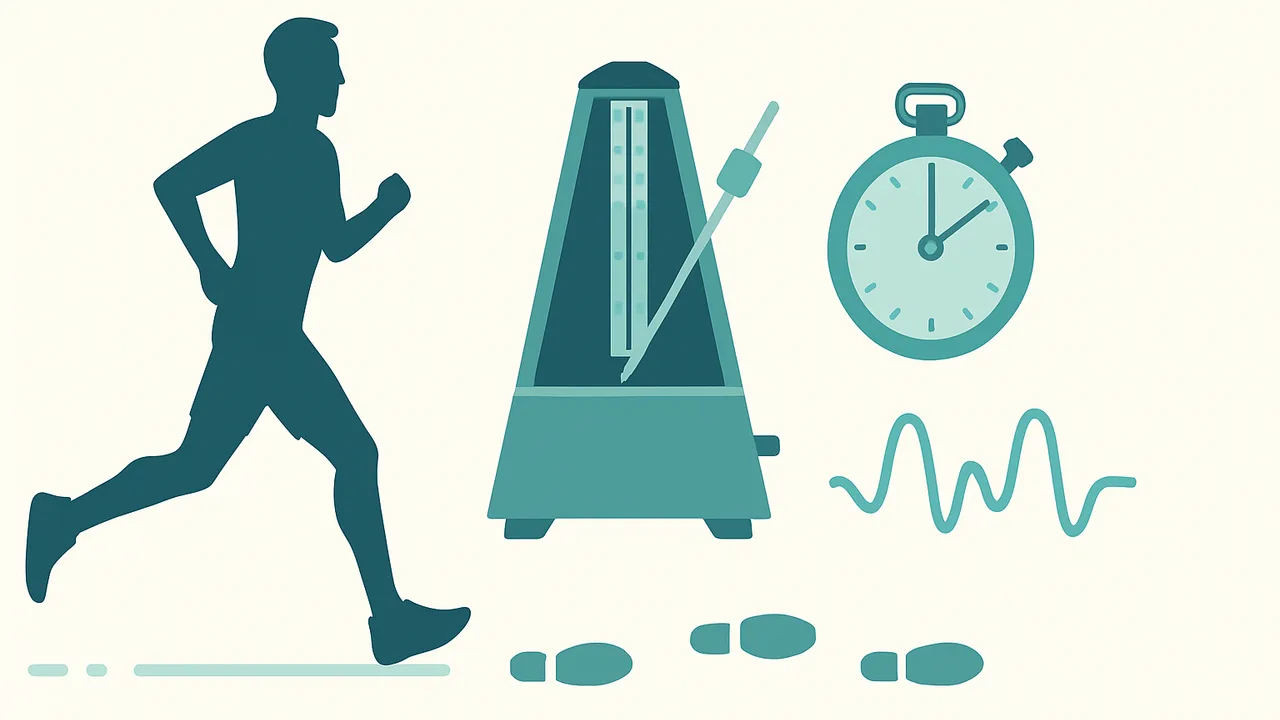
Running cadence is the number of times your feet hit the ground per minute, measured in steps per minute (spm). Both left and right feet count. In cycling, cadence means pedal revolutions (rpm), so it helps to keep the two apart.
Running speed is the product of two things:
- Speed (m/min) = cadence (steps/min) × step length (m)
At the same speed, a lower cadence means longer steps and a higher cadence means shorter ones. That is why cadence gets so much attention. When you reach for a long stride, your foot tends to land well in front of your body (overstriding), and every footstrike acts a little like a brake, sending the impact into your knees and shins. A slightly higher cadence brings the landing point back under your center of mass and reduces that braking.
So cadence is less a goal in itself and more a handle you can pull to fix an overly long stride.
2. Where the number 180 came from
The figure traces back to American running coach Jack Daniels. At the 1984 Los Angeles Olympics he counted the steps of distance runners and noticed that almost all of the elite athletes ran at 180 steps per minute or more. Through his books and talks, that observation hardened into a rule: good runners run at 180.
A few important conditions got lost along the way:
- The runners were Olympic-level athletes, generally lighter, stronger and springier than recreational runners.
- They were measured at race pace, roughly 3 minutes per kilometer. Cadence naturally rises as you run faster.
- Differences in height and leg length were not taken into account.
Daniels was mostly pointing out that many runners take far too few, far too long steps, not prescribing 180 as an absolute value for everyone. Reading it as "if it is very low, it is worth raising" is closer to the original point than "anything below 180 is wrong."
3. Average cadence for recreational runners, and why it varies
Across various measurements, recreational runners mostly fall between about 150 and 170 steps per minute. Around 160 is common at an easy jogging pace, and recreational runners who hold 180 or more on easy runs are rarer than you might expect. If you are between 160 and 170, you are well within the normal range.
Four factors shape your cadence:
| Factor | Effect on cadence | Notes |
|---|---|---|
| Pace (speed) | Rises as you speed up | The same runner can differ by 10 to 20+ steps between an easy jog and intervals |
| Height and leg length | Tends to be lower for taller runners | Longer legs naturally produce a longer step at the same speed |
| Gradient and terrain | Rises on hills and trails | Steps shorten and step count goes up on climbs |
| Fatigue | Tends to drop as you tire | Cadence often sags late in a run while the stride stretches out |
That is why comparing your cadence at the same pace over time tells you more than comparing it with someone else's. A 168 for a 185 cm runner and a 168 for a 160 cm runner do not mean the same thing.
4. Cadence and step length by pace
Using the formula above (speed = cadence × step length), you can see how much your step length changes when you change cadence at a given pace. The table converts each per-kilometer pace into meters per minute and works out the step length at 160, 170 and 180 spm.
| Pace (per km) | Distance per minute | Step length at 160 spm | At 170 spm | At 180 spm | Typical recreational cadence |
|---|---|---|---|---|---|
| 7:00 | about 143 m | 0.89 m | 0.84 m | 0.79 m | 155–165 |
| 6:00 | about 167 m | 1.04 m | 0.98 m | 0.93 m | 160–170 |
| 5:30 | about 182 m | 1.14 m | 1.07 m | 1.01 m | 163–173 |
| 5:00 | 200 m | 1.25 m | 1.18 m | 1.11 m | 167–177 |
| 4:00 | 250 m | 1.56 m | 1.47 m | 1.39 m | 175–185 |
The last column is a rough guide to what runners of average build commonly show, and individual variation is large. If you think in miles, 6:00/km is about 9:39 per mile and 5:00/km is about 8:03 per mile.
Two things stand out. First, going from 160 to 170 at 6:00/km shortens each step by only about 6 cm. You are not being asked to shuffle, just to trim each step a little. Second, forcing 180 at a slow pace pushes step length below 0.8 m, which can feel like running in place. If 180 feels awkward on easy jogs, the likely reason is that the target does not match the speed, not that your form is bad.
5. How to judge your ideal cadence
Instead of chasing a fixed number, use these checks.
Start by measuring accurately. Once you are warmed up at your usual easy pace, count how many times one foot (say, your right) lands in 30 seconds, then multiply by 4. If your right foot lands 41 times, your cadence is 41 × 4 = 164. A stopwatch makes the timing easy, and if you have a watch, compare its average for the same pace segment.
Then look at your situation:
- Below 155 at an easy pace, with loud, heavy footstrikes or recurring pain at the front of the knee or along the shins: raising it is well worth trying.
- Between 160 and 170, running pain-free: there is no rush to change. If you want to experiment, raise it by about 5% and see how your body responds.
- Already 175 or higher: your time is better spent on strength, endurance and pacing.
Research also measures change against your current value, not against 180. In a 2011 study by Heiderscheit and colleagues, increasing step rate by 5 to 10% at the same speed noticeably reduced loading at the knee and hip, with the 10% increase cutting the energy absorbed at the knee substantially. For a runner at 160, something like 168 to 176 is a realistic first target.
6. A step table for raising cadence by 5% at a time
Raising your cadence in two 5% steps is gentler than jumping straight to 180. Find the row closest to your current cadence and set the metronome to that BPM.
| Current cadence | Step 1 (+5%) metronome BPM | Step 2 (+10%) metronome BPM | Suggested time per step |
|---|---|---|---|
| 150 | 158 | 165 | 2–3 weeks each |
| 155 | 163 | 171 | 2–3 weeks each |
| 160 | 168 | 176 | 2 weeks each |
| 165 | 173 | 180 | 2 weeks each |
| 170 | 178 | 180+ optional | 1–2 weeks each |
How to progress:
- Week 1: During an easy run, alternate 1 minute on the metronome with 2 minutes at your normal rhythm, 5 or 6 times. This is where your body learns the new beat.
- Week 2: Extend the metronome blocks to 3 minutes with 1 minute free.
- Week 3 onward: Run the whole easy run on the metronome, then switch it off and check whether the rhythm holds. If it does, move to the next BPM.
It also helps to know where people get stuck. More steps mean more work for your calves and Achilles tendons. Some calf tightness in the first week or two is common, but if the pain is sharp or does not settle after a few days, drop back one step. It is also easy to speed up without meaning to when the BPM rises. The point of the drill is shorter steps at the same speed, so if you start breathing harder, shorten your step further and hold your pace.
Leave the metronome off for intervals and race-pace sessions. Cadence rises on its own at faster speeds, so learning the new rhythm on easy runs is enough.
7. Setting up a browser metronome for running
You do not need a dedicated running metronome app. An online metronome in your phone's browser does the same job. The key rule is simple: one BPM equals one step. If one foot lands on every click, the BPM you set is your cadence.
Setup:
- Open the metronome and type your target from the step table into the BPM field (for example 168). The ±1 buttons let you fine-tune one step at a time.
- Choose the 2/4 time signature. The first of every two beats is accented, so landing the same foot (say, your right) on every accent makes the left-right rhythm easy to lock in.
- Turn the volume up, press Start, and keep the screen on with the phone in a pocket or armband.
If clicks at 170 to 180 BPM feel too busy, use half time. Set 84 BPM instead of 168 and land your right foot on every click; your actual cadence is still 168, and the slower click is easier to listen to on long runs.
If you do not know your current cadence, the Tap tempo button helps. Jog lightly on the spot at your usual rhythm and tap each time a foot lands; the tool averages the most recent intervals to give an approximate BPM. Running in place tends to read a bit higher than real running, so confirm with the 30-second count above.
With Bluetooth earbuds the sound may arrive a fraction later than the on-screen flash, but the delay is constant, so it does not affect your rhythm. The real advantage is that you never have to hunt for 180 BPM playlists: change one number and you have the next target tempo.
8. Frequently asked questions (FAQ)
Q1. Is a cadence of 160 too low?
It is common for recreational runners at an easy pace. If you run without pain, it is hard to call it a problem. If footstrikes feel heavy or knee and shin pain keeps returning, try raising it about 5%, to around 168.
Q2. Should tall runners aim for 180 too?
Not necessarily. Longer legs naturally produce longer steps at the same speed, so a lower cadence is normal. Finding a comfortable point within 5 to 10% above your current value is a more realistic target regardless of height.
Q3. Will raising my cadence make me faster?
Taking more steps at the same step length would make you faster, but the goal of this drill is shorter steps at the same speed. Focus on keeping your usual pace at first; speed gains come later as endurance and strength build.
Q4. Is there a real difference between 170 and 180?
Studies found meaningful changes based on the percentage increase from your current value, not on a specific number. Going from 170 to 180 is about a 6% increase, so it may help, but if you already run pain-free at 170 the difference may be small. Let your body's response guide the decision rather than forcing it.
9. Start your cadence drill today with the metronome
The real question is not "is 180 right?" but "how much should I raise my cadence from where I am, and at what rhythm?" Open the metronome, enter the target BPM from the step table (168 if you are at 160), pick 2/4 and press Start. Matching one step to each click is all it takes to begin. It covers 30 to 250 BPM in single-beat steps, Tap tempo gives you a rough read on your current rhythm, and it opens straight in your phone browser with no app to install.
To measure your current cadence precisely before you start, use the timer and stopwatch to time 30 seconds while you count one foot's landings, then multiply by 4. It is also handy for interval blocks like "1 minute on the metronome, 2 minutes free," so you never miss a switch.