Your doctor says "you are 24 weeks and 3 days today," and then a relative asks the obvious question: "So how many months is that?" Divide 24 by 4 and you get 6. One chart online says 7 months, a calendar count says about 5 and a half, and an English pregnancy app says you are in month 6. None of these is wrong. There are two common ways to turn weeks into months, plus a difference between "completed months" and "the month you are in," and together they make the same week show up as different months in different sources. This guide gives you the numbers first: a side-by-side conversion chart, a quick method for converting the week count your clinic gives you, and a way to work backward from a due date. After that, it explains why 40 weeks is traditionally called "10 months" in Korea and Japan but "nine months" in English.
1. Pregnancy weeks to months chart: 4-week months vs calendar months
Start with the 4-week system, which is the standard way of counting pregnancy months in Korea and Japan. Each "month" is exactly 4 weeks, and the first 4 weeks are month 1.
| Pregnancy month (4-week system) | Week range | Trimester |
|---|---|---|
| Month 1 | 0w 0d to 3w 6d | 1st |
| Month 2 | 4w 0d to 7w 6d | 1st |
| Month 3 | 8w 0d to 11w 6d | 1st |
| Month 4 | 12w 0d to 15w 6d | 1st, then 2nd from week 14 |
| Month 5 | 16w 0d to 19w 6d | 2nd |
| Month 6 | 20w 0d to 23w 6d | 2nd |
| Month 7 | 24w 0d to 27w 6d | 2nd |
| Month 8 | 28w 0d to 31w 6d | 3rd |
| Month 9 | 32w 0d to 35w 6d | 3rd |
| Month 10 | 36w 0d to 39w 6d | 3rd |
Week 40 day 0 is the estimated due date, the day the tenth month is complete. Because the first trimester runs through 13 weeks 6 days, the trimester changes in the middle of month 4.
Now compare the same weeks counted in calendar months. An average calendar month is 30.44 days (365.25 ÷ 12), so multiply the weeks by 7 to get days and divide by 30.44.
| Weeks | 4-week: completed months | 4-week: month you are in | Calendar: months elapsed | Calendar: month you are in |
|---|---|---|---|---|
| 4w 0d | 1 | Month 2 | about 0.92 | Month 1 |
| 8w 0d | 2 | Month 3 | about 1.84 | Month 2 |
| 12w 0d | 3 | Month 4 | about 2.76 | Month 3 |
| 16w 0d | 4 | Month 5 | about 3.68 | Month 4 |
| 20w 0d | 5 | Month 6 | about 4.60 | Month 5 |
| 24w 0d | 6 | Month 7 | about 5.52 | Month 6 |
| 28w 0d | 7 | Month 8 | about 6.44 | Month 7 |
| 32w 0d | 8 | Month 9 | about 7.36 | Month 8 |
| 36w 0d | 9 | Month 10 | about 8.28 | Month 9 |
| 40w 0d | 10 (due date) | Month 10 complete | about 9.20 | Month 10 |
Read across a row and the confusion disappears. At 24 weeks, "6 months," "month 7," "about 5.5 calendar months," and "calendar month 6" all describe the same day. The gap between the two systems widens as the pregnancy progresses, reaching about 0.8 of a month, a little over three weeks, by week 40.
2. Converting your "N weeks M days" to months, with three examples
Three steps cover almost every case.
- Look at the weeks only. For "24 weeks 3 days," drop the 3 days for now. The 4-week system moves in whole weeks, so the extra days never change the month.
- Divide the weeks by 4. The whole-number result is the completed months, and adding 1 gives the month you are in. 24 ÷ 4 = 6, so 6 completed months, month 7.
- If you need calendar months, divide total days by 30.44. 24 weeks 3 days is 24 × 7 + 3 = 171 days, and 171 ÷ 30.44 ≈ 5.62, so about 5 months and 19 days have passed: calendar month 6.
A few more examples:
- Example A, 13 weeks 4 days: 13 ÷ 4 = 3 remainder 1, so 3 completed months, month 4. That is 95 days, and 95 ÷ 30.44 ≈ 3.12, so calendar month 4 as well. Early on, the two systems usually agree.
- Example B, 24 weeks 3 days: month 7 in the 4-week system, calendar month 6. From the second trimester on, the systems start to differ by a month.
- Example C, 32 weeks 0 days: this is exactly the first day of month 9 in the 4-week system. 224 days ÷ 30.44 ≈ 7.36, so calendar month 8.
When someone asks "how many months?", it helps to say which system you used. Better still, give the week count, since that is what every clinic uses.
3. Working backward from your due date
If you only remember your due date, you can still recover your week count. The due date is the first day of your last menstrual period (LMP) plus 280 days (40 weeks), so subtracting the days left from 280 gives the days elapsed.
- Days pregnant = 280 − (due date − today)
- Weeks = days pregnant ÷ 7, with the remainder as extra days
Say your due date is May 1, 2027, and today is October 28, 2026. There are 185 days to go. 280 − 185 = 95 days, which is 13 weeks 4 days, month 4, just like Example A. The matching LMP would be July 25, 2026.
| Days until due date | Days pregnant | Weeks | 4-week month | Calendar month |
|---|---|---|---|---|
| 245 | 35 | 5w 0d | Month 2 | Month 2 |
| 185 | 95 | 13w 4d | Month 4 | Month 4 |
| 109 | 171 | 24w 3d | Month 7 | Month 6 |
| 56 | 224 | 32w 0d | Month 9 | Month 8 |
| 21 | 259 | 37w 0d | Month 10 | Month 9 |
The step most likely to go wrong is counting the days by hand, because months have different lengths. Let a tool count the days and use the formula only for the conversion. If your clinic moved your due date after an ultrasound, count back from the updated date so your numbers match your records.
4. Why 40 weeks is "10 months": the 28-day pregnancy month
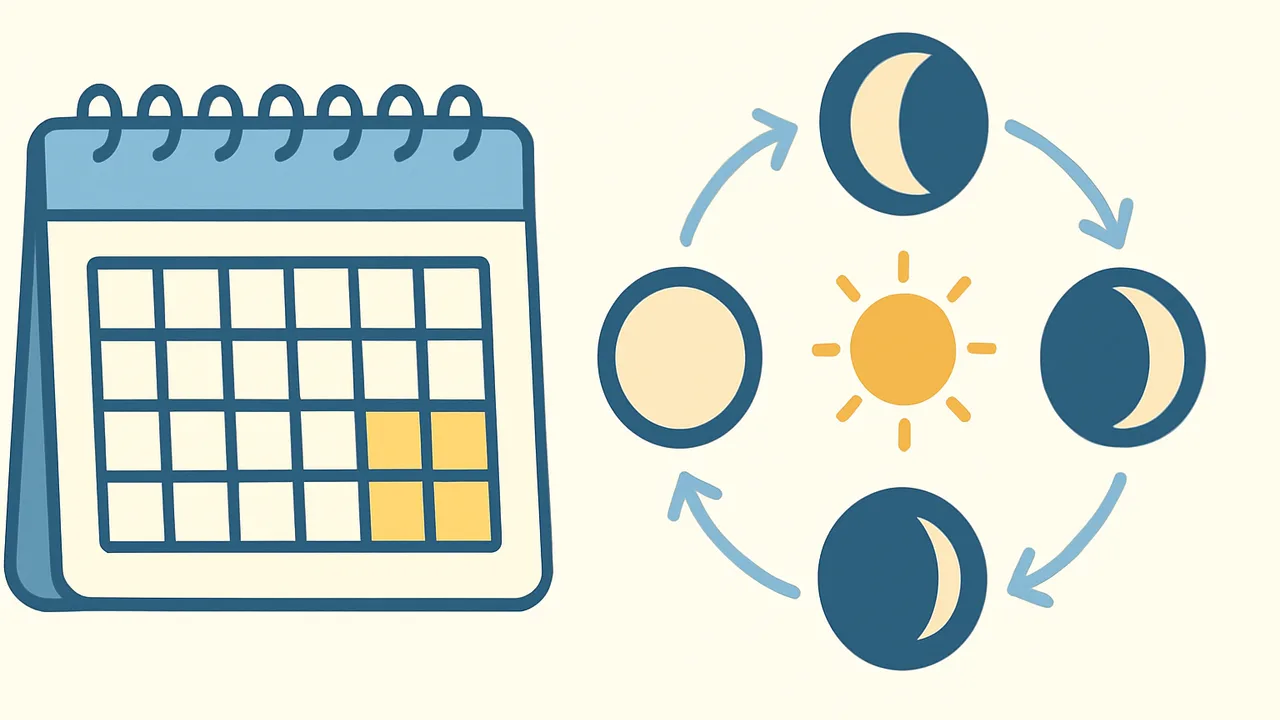
The idea that a baby arrives after ten months comes from counting in 28-day months, not calendar months. The lunar cycle is about 29.5 days, and traditional reckoning rounded it to four weeks. A 28-day pregnancy month is always exactly 4 weeks, which keeps the arithmetic tidy.
280 days divided by 28 is exactly 10. That is why "10 months = 40 weeks = 280 days" holds in this system, and why Korean and Japanese pregnancy guides, mother-and-child health handbooks, and everyday conversation still count pregnancy months in 4-week blocks. If you live in Korea and a friend or coworker asks how many months along you are, they almost certainly mean the month you are in under this system.
The other key point is the starting line. Pregnancy weeks are counted from the first day of the last period, not from conception. Ovulation and fertilization usually happen about two weeks later, so when a test turns positive and the clinic says "5 weeks," the embryo has been developing for roughly 3 weeks. Most people know their period start date far more reliably than their ovulation date, which is why medicine uses LMP as the common reference.
5. Why calendar months give "nine months"
A calendar month averages 30.44 days, not 28. Divide 280 days by 30.44 and you get about 9.2 months, which is where the English phrase "nine months" comes from. Strictly speaking, a full-term pregnancy is nine months plus roughly six days.
| System | Length of one month | 280 days divided | What people call it |
|---|---|---|---|
| 4-week (pregnancy month) | 28 days | 10.0 months | 10 months (Korea, Japan) |
| Calendar month | 30.44 days on average | about 9.2 months | nine months |
| From conception (fetal age) | 30.44 days on average | 266 ÷ 30.44 ≈ 8.7 months | 38 weeks after conception |
So "10 months" and "9 months" are the same length of time measured with different rulers. The 4-week system uses a shorter month and needs one more of them. The calendar system uses a longer month and finishes a little past nine.
Many English-language pregnancy resources go one step further and split nine months to line up with trimesters: months 1 to 3 in the first trimester, 4 to 6 in the second, 7 to 9 in the third. To make that work, some months get four weeks and others five. Those charts will not line up with a Korean 10-month chart, so expect month boundaries to shift by a week or more when you compare them.
6. Four reasons the same week appears as different months
If every chart you find disagrees, one of these is the cause.
- Completed months vs the month you are in. It works like age: a baby who has completed 3 months is in their fourth month. A source that calls 12 weeks "3 months" uses completed months, and one that calls it "month 4" counts the month you are in. Both mean the same day.
- 4-week months vs calendar months. The 4-week system divides 40 weeks into 10 months, the calendar system into about 9.2. From mid-pregnancy on, the same week lands in different months.
- Different starting points. Most sources count from LMP, but some fetal development guides count from conception, which shows the same day as two weeks less.
- Trimester-aligned 9-month charts. Charts that assign 4 or 5 weeks per month to fit trimester boundaries will not match a strict 4-week chart.
When comparing months, check where the source starts counting, how long its month is, and whether it gives completed months or the current month. Clinicians avoid the whole issue by always speaking in weeks and days.
7. Which system to use in which situation
Match the system to your listener and your purpose.
- Prenatal appointments, test schedules, and paperwork: use weeks and days exactly, such as 24w 3d. Screening windows and leave rules are almost always defined by weeks, and converting to months only blurs the boundaries.
- Talking with family and friends in Korea or Japan: the 4-week "month you are in" is the norm. "Month 7" will usually be understood as weeks 24 to 27.
- Talking with people back home who use calendar months: their "7 months" may describe a later stage than the Korean month 7. Switching to weeks avoids a mismatch.
- Planning purchases or events on a calendar: calendar months are easier when dates matter. Count back from your due date.
- Early pregnancy: remember that LMP-based weeks run about two weeks ahead of time since conception. The 5 weeks your clinic mentions is LMP-based.
Keep in mind that relatively few babies arrive exactly on the due date. Full term starts at 37 weeks, which is month 10 in the 4-week system and calendar month 9, so birth can come at any point from then on.
8. Frequently asked questions
Q1. How many months is 20 weeks pregnant?
In the 4-week system, 20 ÷ 4 = 5, so 5 completed months and the first day of month 6. In calendar terms, 140 days ÷ 30.44 ≈ 4.6 months, which is calendar month 5. In Korea, "6 months pregnant" usually means 20 weeks 0 days through 23 weeks 6 days.
Q2. Does "10 months pregnant" mean a full 40 weeks?
In the 4-week system, month 10 runs from 36 weeks 0 days to 39 weeks 6 days, and 40 weeks 0 days is the due date, when the tenth month is complete. "Entering month 10" means you are past 36 weeks, while "completing 10 months" means you have reached the due date.
Q3. Why do English speakers say pregnancy lasts nine months?
Because 280 days divided by an average calendar month of 30.44 days is about 9.2 months. Korea and Japan use 28-day months, so the same span is expressed as 10 months. The actual length, 40 weeks from LMP, is the same in both cases.
Q4. Are pregnancy weeks counted from conception or from my last period?
Clinics count from the first day of your last menstrual period. If you know your conception date, add 266 days to estimate the due date, and add 2 weeks to the time since conception to match LMP-based weeks. If your due date was adjusted by ultrasound, follow the date your clinic gave you.
9. Find your exact weeks and months with the due date calculator
The hardest part of all this is knowing exactly how many weeks and days you are today. Enter your last period start date or conception date in the due date calculator and it shows your due date along with your current week count (N weeks M days), trimester, and D-day countdown. Divide those weeks by 4 for completed months, add 1 for the month you are in, and check the result against the chart in section 1. It also lists the dates you reach key milestones such as 12, 20, and 37 weeks, so you can mark on your calendar when each new month begins.
If you only know your due date, use the date calculator to count the days from today to that date, then apply the formula in section 3 (280 minus days remaining). If you are still trying to conceive, the ovulation calculator shows your fertile window, which also makes it clear why LMP-based weeks run two weeks ahead of conception. These results are estimates for reference only; for anything related to your care, go by the weeks and due date your healthcare provider gives you.