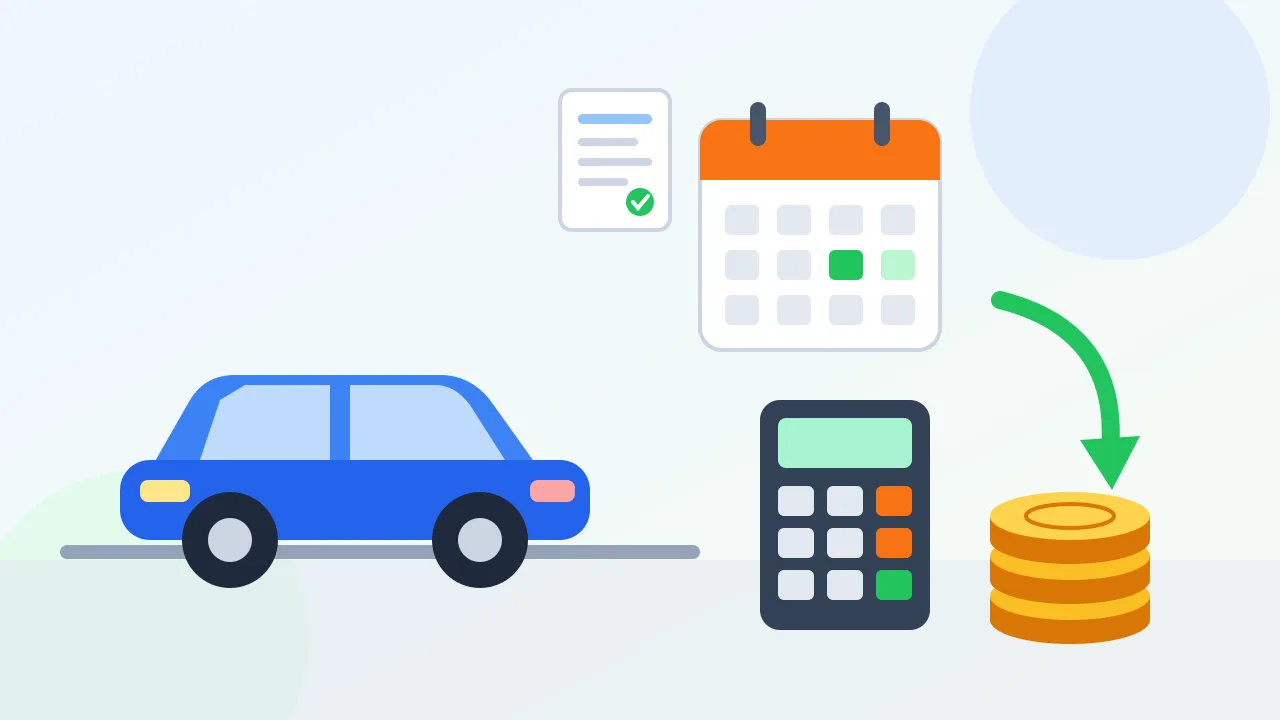
You paid a full year of Korean car tax (jadongcha-se, 자동차세) in January to get the early-payment discount, and then sold the car in spring. Or you scrapped an old car in the autumn, or you are leaving Korea and need to get rid of your vehicle before your flight. The natural question is whether the months you already paid for are simply lost.
They are not. Korean car tax is charged only for the days you actually owned the vehicle, so the part of the tax that covers days after the car left your name comes back to you. Whether that shows up as a cash refund or just as a smaller next bill, however, depends on how you paid and on the exact date ownership changed. This guide explains who actually gets a refund, how the daily proration works, what the numbers look like for common engine sizes, how to claim the money, and what foreign residents should keep in mind.
1. When a Refund Happens and When It Does Not
Korea splits the car tax year into two halves. The first half (January to June) is billed in June, and the second half (July to December) is billed in December. If you pay the rest of the year in one go in January (or in March, June or September), you get a discount. This is called annual prepayment, or yeonnap (연납).
A refund only exists when the tax you have already paid covers more days than you actually owned the car.
| Situation | Outcome | Why |
|---|---|---|
| Prepaid in January, then sold or scrapped mid-year | Refund | You paid for the full year, so the days after the transfer or deregistration come back |
| Paying regular bills, sold before the June bill | No refund | The June bill is simply prorated to the days you owned the car |
| Paying regular bills, sold between July and November | No refund | The December bill covers only July 1 to your last day of ownership |
| Paid a half-year bill, then sold within that same half | Small refund possible | For example, paid the June bill and the transfer was registered later in June |
| You are the buyer | Not applicable | The days after the transfer are billed to you on the next regular bill |
In practice, the people waiting for a refund are almost always those who prepaid. If you were on regular billing, there is nothing to refund; your next bill just shrinks.
2. The Key Date Is the Registration Date, Not the Contract Date
The most common mistake is using the wrong date. What counts is the date the change appears in the vehicle register, not the day you signed the sales contract or handed over the keys.
- Sale: the ownership transfer registration date is the dividing line between seller and buyer.
- Scrapping: your share runs up to the deregistration date, not the day the scrapyard picked up the car.
- Export: the export deregistration date is used.
If you signed in early March but the transfer was only registered at the end of March, the tax for the days in between stays with you. The same applies when you sell to a used-car dealer: what matters is the day the car was registered in the dealer's name. Which side pays for the boundary day follows local government practice and is worth only a few hundred won either way.
3. The Proration Formula, Step by Step
For a non-commercial passenger car, the annual car tax is engine displacement times a per-cc rate: 80 won up to 1,000cc, 140 won up to 1,600cc, and 200 won above 1,600cc. A local education tax of 30% of the car tax is added on top. Cars aged three years or more get a reduction that starts at 5% in the third year and grows by 5% a year up to 50%. Electric and hydrogen cars pay a flat 100,000 won a year plus the 30% education tax.
The refund is worked out like this:
- Annual car tax = displacement × per-cc rate × (1 − age reduction)
- Annual total = annual car tax × 1.3 (education tax included)
- January prepayment = annual total × (1 − about 4.58%), an approximation of the 5% deduction rate applied to the remaining 11 months
- Refund = January prepayment × (days remaining after the transfer or deregistration ÷ 365)
The prepayment discount was given on the assumption that you would pay for the full year, so you do not keep the discount for the days after the car left your name. In other words, the refund is proportional to what you actually paid, not to the undiscounted amount. Real figures can differ by a few dozen won because amounts under 10 won are cut off and local offices round slightly differently.
4. Refund Examples by Date: 1,598cc and 1,999cc, New and Seven Years Old
The table below assumes the tax was prepaid in January 2026 and the transfer (or deregistration) was registered on April 1, July 1 or October 1. That means ownership through March 31, June 30 or September 30, leaving 275, 184 or 92 days. The seven-year-old cars were first registered in 2020 and get a 25% age reduction.
| Vehicle | Annual total (incl. education tax) | January prepayment | Refund, registered Apr 1 | Refund, registered Jul 1 | Refund, registered Oct 1 |
|---|---|---|---|---|---|
| 1,598cc, new | 290,836 won | ≈ 277,500 won | ≈ 209,000 won | ≈ 139,900 won | ≈ 69,900 won |
| 1,999cc, new | 519,740 won | ≈ 495,900 won | ≈ 373,600 won | ≈ 250,000 won | ≈ 125,000 won |
| 1,598cc, 7 years old | 218,127 won | ≈ 208,100 won | ≈ 156,800 won | ≈ 104,900 won | ≈ 52,500 won |
| 1,999cc, 7 years old | 389,805 won | ≈ 371,900 won | ≈ 280,200 won | ≈ 187,500 won | ≈ 93,700 won |
The refund scales almost exactly with the remaining days. Selling a new 1,999cc car in early April returns more than 370,000 won; waiting until October cuts that to about 125,000 won.
For comparison, if the same new 1,999cc car had been on regular billing and the transfer was registered on April 1, there would be no refund at all. The June bill would simply show about 129,200 won, which is 90 of the 181 days of the 259,870 won first-half tax. The rest is billed to the buyer.
5. Do You Need to Apply? How to Claim the Refund
In principle, the local government receives the transfer or deregistration record and calculates the refund on its own, so you do not need to visit an office with paperwork. The refund is often delayed, though, when the office does not know which bank account to pay into. These steps speed things up:
- Confirm the registration is done. Make sure the transfer or deregistration has actually been processed. If you sold to a dealer, ask them when the transfer was registered.
- Watch for the refund notice. Some time after registration, the local government sends a refund notice by post or electronic notification.
- Check and claim online. On Wetax (wetax.go.kr), use the refund inquiry and application menu, verify your identity, check the car tax item and enter your bank account. Cars registered in Seoul are handled on ETAX (etax.seoul.go.kr) in the same way.
- Register a refund account in advance. Once an account is registered on Wetax, later local tax refunds can be paid without a separate application.
- In person. You can also apply at the tax department of the city, county or district office where the car was registered, bringing ID and a copy of your bankbook.
The right to claim a local tax refund expires after five years, so if you sold a prepaid car a few years ago and never saw the money, it is still worth checking.
6. What Foreign Residents Should Check Before Selling or Leaving Korea
The car tax is calculated from the vehicle itself, by displacement, age and fuel type, so the rates, the prepayment discount and the proration above work the same way whether the owner is Korean or a foreign resident. What tends to be different for foreigners is the logistics around the refund.
- Your registered address is where the notices go. Under the Immigration Act, alien registration and a report of change of residence (체류지 변경신고) take the place of resident registration and move-in reports. If you moved without reporting your new address, refund notices and bills may go to the old one, so report changes of residence promptly.
- Register the sale or deregistration before you leave, not after. The registration date sets the refund, so finishing the transfer or scrapping early in your last weeks in Korea both increases the refund and makes sure the record is complete while you can still deal with it in person.
- Keep a Korean bank account open until the refund arrives. Refunds are paid into a domestic account. Register that account on Wetax (or ETAX in Seoul) before departure so the payment does not depend on a mailed notice reaching you.
- Ask a dealer for proof of transfer. If you sell to a dealer shortly before leaving, ask for confirmation that the transfer has been registered in their name. Until it is, the tax and any fines stay attached to you.
Tax rules and office procedures can change, so confirm the details with the local tax office or Wetax before relying on a specific amount.
7. Frequently Asked Questions
Q1. I prepaid and then moved to another city but kept the car. Do I get a refund?
No. You still own the car, so the tax obligation continues. Refunds only arise when ownership ends through a transfer or deregistration.
Q2. When does the buyer pay car tax for that year?
The days after the transfer registration are prorated onto the next regular bill (June or December). The buyer can also apply for prepayment in March, June or September.
Q3. Is the local education tax refunded too?
Yes. It is attached to the car tax, so it is refunded in proportion. The amounts in the table above include it.
Q4. My refund is slightly different from my own calculation.
Cutting off amounts under 10 won, the handling of the boundary day and the way the prepayment deduction is computed can create differences of tens to a few hundred won. If the gap is thousands of won, double-check the registration date and the year the car was first registered.
8. Work Out Your Own Refund with the Car Tax Calculator
Two numbers decide your refund: your car's exact annual tax and the number of days left after the transfer or deregistration.
Enter the displacement and first registration year into the car tax calculator and it returns the annual car tax with the age reduction applied, plus the January prepayment amount. Multiply that prepayment by the share of the year remaining and you have your expected refund, calculated the same way as the table above. For the remaining days, use the date calculator to count from the registration date to December 31. With both numbers in hand you can check the refund notice as soon as it arrives, and you have something concrete to point to if you need to ask the tax office why the refund has not appeared yet.